
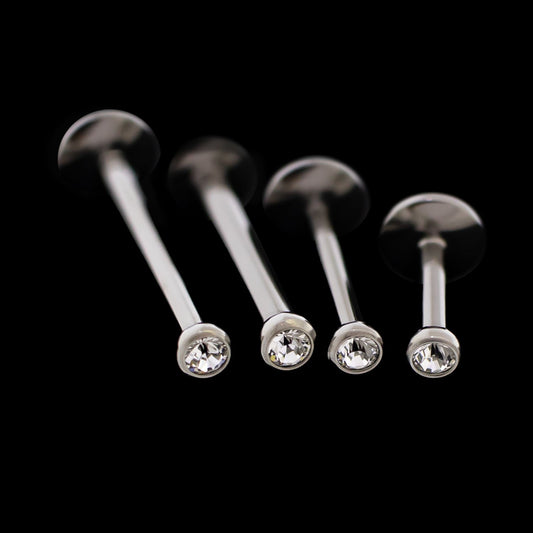
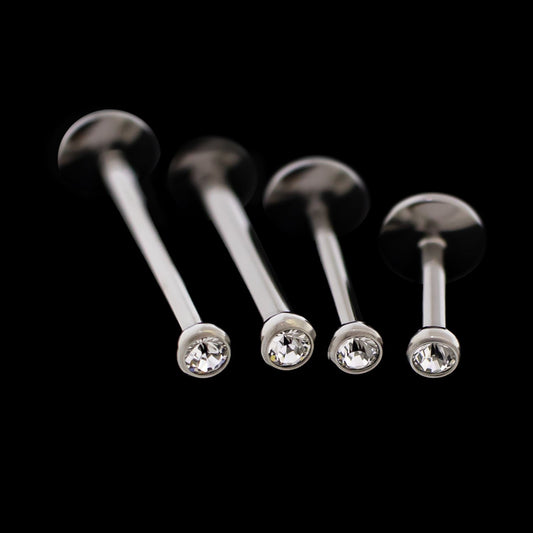
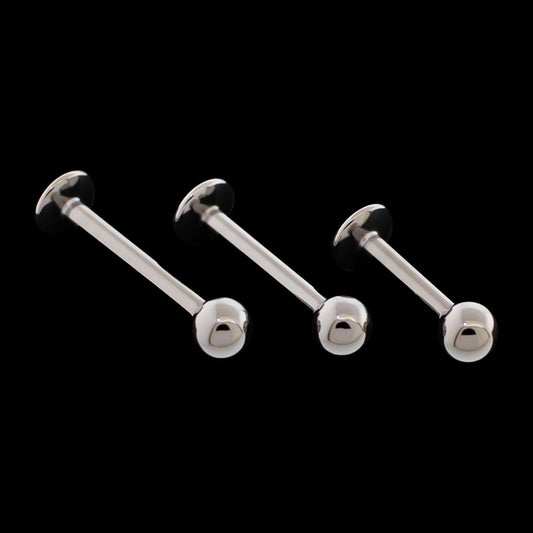
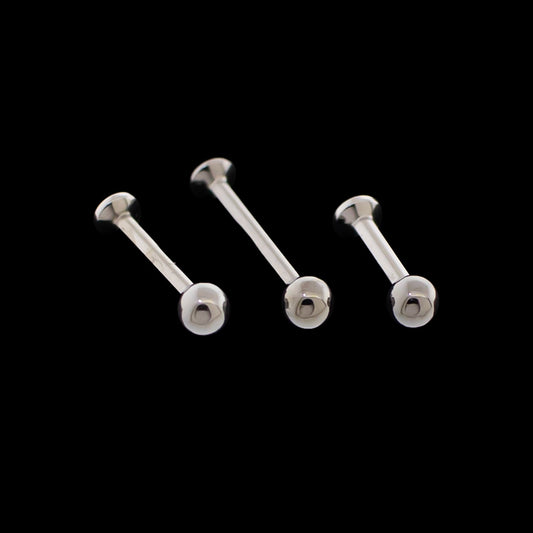
Internally Threaded Titanium Labret Studs - Titanium by Khrysos
The Titanium by Khrysos internally threaded labret collection brings together ASTM F-136 implant-grade titanium, smooth flat back construction, and a fully interchangeable end system. Available in 14G through 18G with multiple length and disc size options, these posts are built for helix, tragus, flat, conch, lobe, lip, and facial piercings. Designed for fresh placements, downsizing, and long-term daily wear.
What Is an Internally Threaded Labret and Why Does It Matter?
If your piercer recommended an internally threaded titanium labret or you have been researching why piercings heal better with certain jewelry, this section breaks down what distinguishes this design from other options on the market.
The Flat Back Design Explained
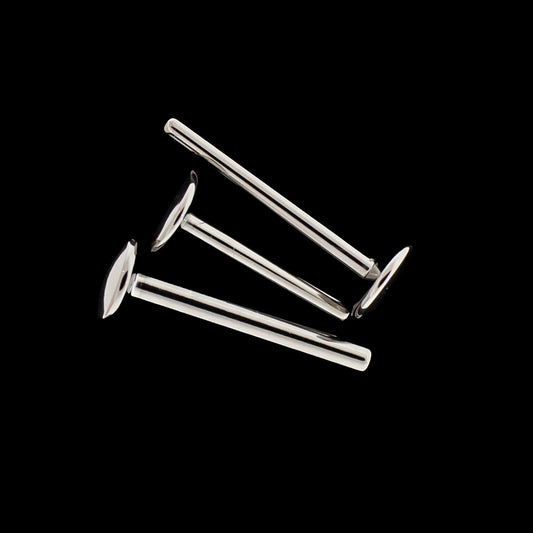
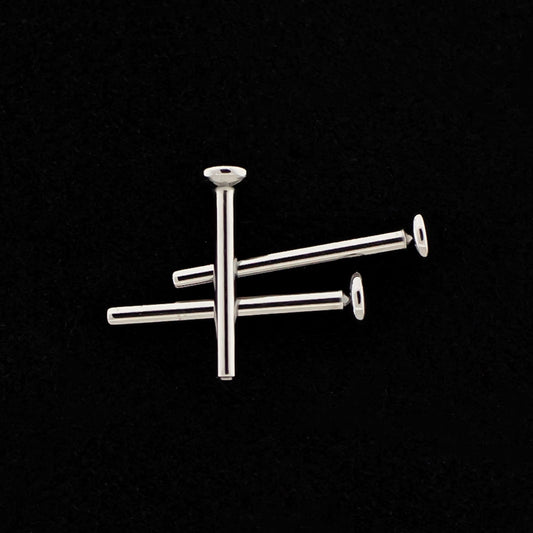
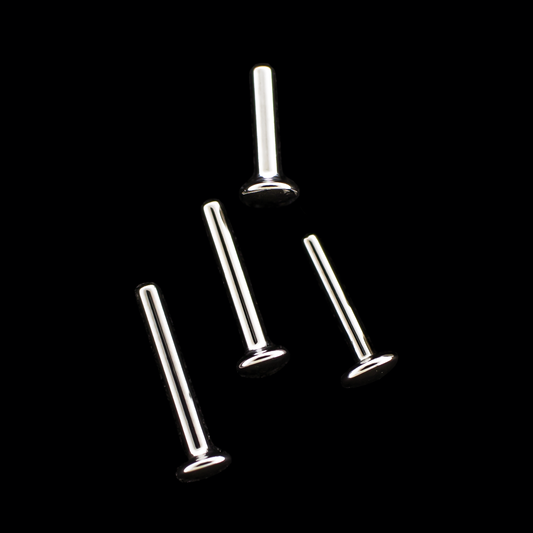
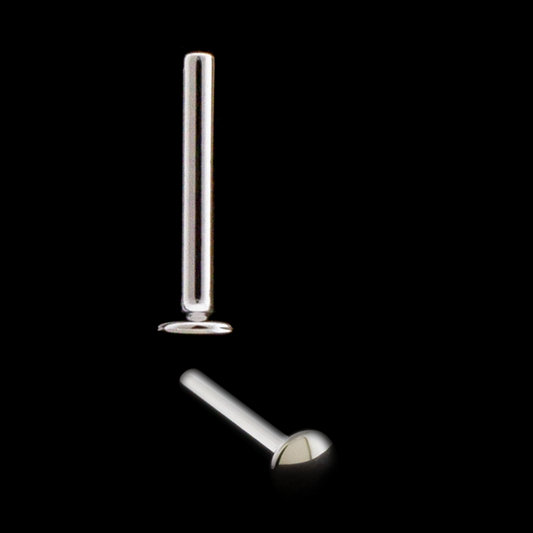
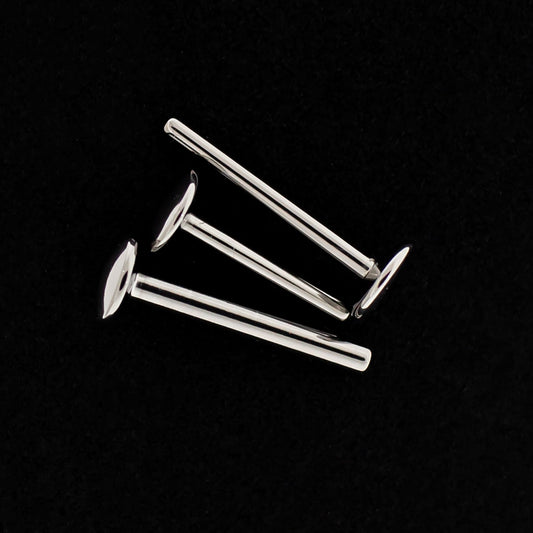
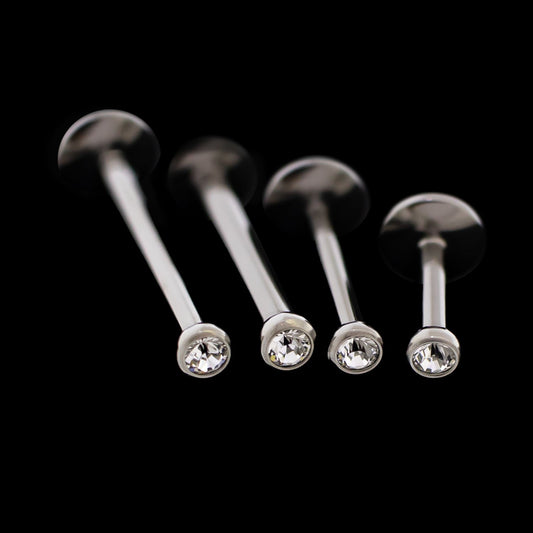
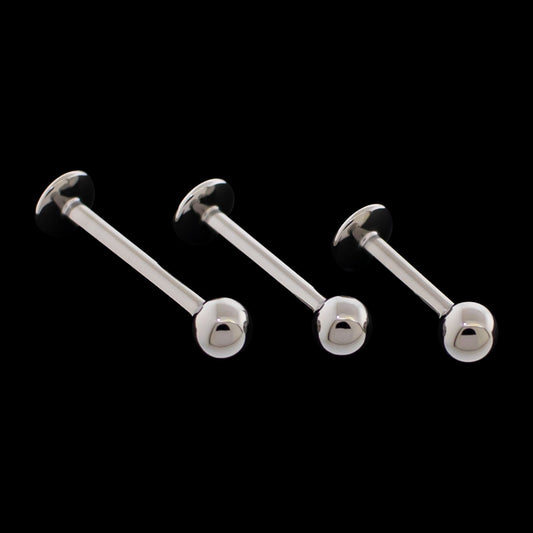
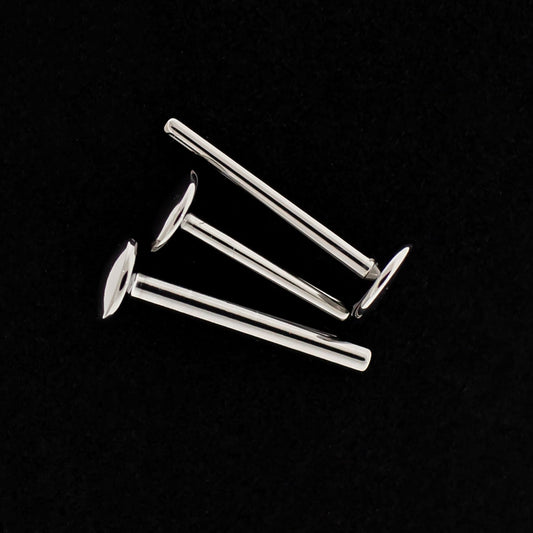
A flat back labret is a straight post with a flat disc at one end and a removable decorative end at the other. The flat disc of an internally threaded labret sits flush against the inside of the piercing, unlike a butterfly back or ball back that protrudes outward and creates pressure on the surrounding tissue. With an internally threaded labret, the post shaft is completely smooth from tip to back. The decorative end has a small screw pin at its base that threads into the hollow interior of the post. No exposed threads ever contact piercing tissue during insertion, removal, or jewelry changes. This is the design standard the Association of Professional Piercers recommends for all piercings, fresh or healed.
Internally Threaded Labret vs. Threadless Labret, Which One Do You Have?
Both internally threaded and threadless labrets share the same flat back labret post design. The difference is in how the decorative end attaches. An internally threaded labret end screws in via a small metal pin with thread grooves. A threadless labret top pushes in via a slightly bent pin that creates tension inside the post and holds without screwing. Both systems use smooth posts, and both are APP-approved for safe wear.
The practical implication: if your studio or piercer uses internally threaded jewelry, your posts and ends must match that system. Threadless tops will not work with an internally threaded post, and internally threaded ends will not hold in a threadless post. If you are unsure which system your current jewelry uses, check whether the top screws off or pops off. Screw off means internally threaded. If you prefer the push-fit system, the threadless labret collection covers that option at the same ASTM F-136 standard.
Placements for Titanium Internally Threaded Labret Studs
The internally threaded labret stud is one of the most versatile jewelry designs in professional piercing. A single post form factor serves dozens of different placements because the flat back works across all tissue types and anatomies. Here is how it applies by placement.
Ear Placements
Helix is the most common placement for an internally threaded labret. The flat back disc sits flush against the back of the ear, preventing the disc from catching on hair or pressing against the pillow during sleep. Flat piercing (scapha) requires a labret by design, the flat surface of the cartilage does not allow hoops to sit correctly, making an internally threaded labret the only appropriate jewelry type for this placement. Tragus and anti-tragus both benefit from the flat back because the tight space between cartilage and ear canal leaves no room for protruding backs. Conch piercings worn with headphones benefit significantly from flat back construction, since disc pressure against ear canal skin during headphone use is eliminated. Lobe and second lobe piercings often transition to titanium labret studs as an upgrade from butterfly backs, particularly after healing is complete and the wearer wants a lower-profile, more secure option for daily wear.
Facial and Body Placements
Lip and labret piercings are the original namesake placement for this jewelry style. The flat disc back does not contact teeth or gums during normal mouth movement, reducing the long-term dental wear risk associated with ball-back labrets. Philtrum (medusa) and Monroe piercings use the same post design with the flat disc sitting behind the upper lip. Nostril piercings at 18G and 20G use short internally threaded labret posts for the lowest visible profile of any nose jewelry style. Cheek (dimple) piercings in titanium labret jewelry require longer initial lengths to accommodate the significant swelling during fresh healing, with downsizing to shorter posts once healing stabilizes. The flat back labret construction is essential here because the disc needs to distribute pressure across a wider tissue surface than a simple ball end would.
How to Choose the Right Internally Threaded Labret Size
Three variables determine the right internally threaded labret for your placement: gauge, length, and disc size. Getting all three right from the start eliminates the most common causes of irritation and the need for exchanges.
Gauge Selection
Gauge refers to the thickness of the post shaft. The standard for most cartilage piercings, helix, tragus, flat, conch, anti-tragus, and forward helix, is 16G (1.2mm). This is also the standard for most facial piercings including philtrum, Monroe, and cheek placements. 18G (1.0mm) is used for lobe, second lobe, nostril, and some lighter cartilage placements depending on piercer preference and anatomy. 14G (1.6mm) applies to labret and lip placements where the wearer prefers heavier jewelry or has stretched the placement over time. The gauge your piercer originally used for your placement is the gauge you need. Changing gauge requires a new piercing or gradual stretching and is not something to experiment with when purchasing jewelry.
Length Selection by Placement
Length is the wearable shaft measurement from the back of the flat disc to the tip where the end attaches. Standard length guidance by placement:
- Helix, tragus, flat, forward helix: 6mm for healed placements, 8mm for thicker cartilage
- Conch: 6–8mm depending on anatomy
- Lobe and second lobe: 6mm standard, 8mm for thicker lobes
- Nostril: 6mm in most cases
- Lip and labret: 8–10mm when fresh, 6–8mm once healed
- Philtrum and Monroe: 8mm fresh, 6mm healed
- Cheek piercings: 12–14mm initially to accommodate swelling, downsized after 6–8 weeks
Fresh piercings always need a longer post than a healed placement. The extra length accommodates the swelling that occurs in the first several weeks. Wearing too short a post on a fresh piercing restricts circulation to the tissue and significantly slows healing. Downsizing to the correct shorter length once swelling subsides is standard professional practice and is best done at the studio with your piercer's assistance rather than at home.
Flat Back Disc Size
The flat disc is the back of the internally threaded labret post, the surface that sits inside the piercing against the tissue. This detail is often overlooked when selecting labret jewelry, but disc size directly affects long-term comfort. A disc that is too small can apply concentrated pressure on a small area of tissue, potentially leading to embedding over time. A disc that is too large creates a wider pressure surface that can be felt during facial movement or sleep.
For 16G and 18G ear placements (helix, tragus, flat), a 2.5mm disc is the professional standard and the most common default. For lobe, lip, labret, and facial placements where tissue is thicker, a 3mm to 4mm disc distributes pressure more comfortably. When in doubt, match the disc size your piercer originally selected for your jewelry. If you are unsure, 2.5mm is the safe default for ear placements, and 3mm works well for most facial and oral placements.
One Post, Many Looks, The Interchangeable End System
One of the most practical and underappreciated advantages of the internally threaded labret is how it separates the post (which stays in the piercing) from the end (which carries the visual design).
Once an internally threaded labret post is seated correctly in a healed piercing, changing the look requires only swapping the decorative end. The post does not leave the piercing. You unscrew the current end, screw in a new one at the same gauge, and the change is complete without any disruption to the placement. This approach reduces the number of times you insert and remove jewelry through the tissue, which matters especially for cartilage piercings that can be slow to stabilize. It also makes building a curated ear significantly more economical, instead of purchasing complete new jewelry for each look, a single quality post holds different ends for different occasions or aesthetics. All Khrysos internally threaded ends at the same gauge are compatible with these posts.
For the full range of ends available for this system, the internally threaded ends collection covers gems, opals, flat discs, spikes, clusters, and sculptural designs in 14G through 18G.
Why Khrysos Titanium Internally Threaded Labret Studs
The gap between retail-grade and professional-grade internally threaded labret jewelry is real and it shows up in specific ways: inconsistent disc sizing, threading that strips after a few changes, and material claims that do not hold up to scrutiny. Khrysos was built to close that gap.
On material, every post in this collection is ASTM F-136 titanium, Ti6Al4V ELI, nickel-free, and fully biocompatible. This is the explicit standard the APP requires, not a vague "implant grade" or "surgical grade" label. ASTM F-136 is the specification, and Khrysos publishes it because it matters. There are no nickel traces, no base metals, and no coatings on any part of the post.
On color options, ASTM F-136 titanium can be anodized to produce vivid tones, gold, rose gold, black, purple, teal, blue, and high-polish silver, through an electrochemical process that modifies the surface oxide layer without adding any coating or dye. The color is part of the metal surface. It will not peel, chip, or fade, and it does not affect biocompatibility.
On construction, post diameter, flat disc geometry, and thread pitch are machined to professional tolerances throughout the range. The disc is sized correctly for the gauge it accompanies. The threading engages cleanly with Khrysos ends and seats fully without over-tightening. Khrysos offers a lifetime workmanship guarantee on all ASTM F-136 titanium pieces, with replacement provided on return of the original defective piece. Free USPS economy shipping applies to all orders over $25, and domestic orders placed before 1pm are processed the same day.
For the full internally threaded titanium range beyond labrets, the titanium internally threaded collection includes barbells, curved barbells, circular barbells, and industrial barbells at the same material standard.
Frequently Asked Questions About Internally Threaded Titanium Labret Studs
Here are the questions buyers most commonly ask before purchasing from the Khrysos internally threaded labret collection.
What is an internally threaded labret?
A flat back stud with a smooth hollow post where threading sits inside, not on the shaft. The decorative end screws into the post interior via a small pin, keeping the post tissue-safe during all jewelry changes.
What is the difference between an internally threaded labret and a threadless labret?
Both use smooth flat back posts. Internally threaded ends screw in; threadless tops push in via bent-pin tension. Both are APP-approved. Your posts and ends must match the same system, they are not interchangeable with each other.
What gauge should I get for a helix or tragus piercing?
16G is the standard for helix, tragus, flat cartilage, and most facial placements. 18G suits lobe and some nostril placements. Confirm the gauge your piercer originally used before ordering, especially for fresh piercings.
What length should I choose?
6mm is the standard for healed cartilage and lobe placements. Fresh piercings require 8–10mm to accommodate swelling. Downsizing to the correct shorter length once healed is best done with your piercer's help.
Can I sleep in a titanium internally threaded labret?
Yes. The flat back disc sits flush against the ear and creates no pressure points. ASTM F-136 titanium is biocompatible for continuous wear, and the screw-in end stays secure during normal sleep movement.
Can I change the end without removing the post from my piercing?
Yes. The post stays in the piercing. You unscrew the current end and replace it with any same-gauge internally threaded end without disturbing the placement.
Is a titanium internally threaded labret safe for a fresh piercing?
Yes. ASTM F-136 titanium with a smooth internally threaded post is APP-recommended for initial jewelry. Use the correct gauge and a longer length to accommodate swelling during the early healing phase.
Khrysos internally threaded labret studs give you ASTM F-136 material, flat back comfort, smooth post construction, and a fully interchangeable end system in one piece. Whether you are setting up a fresh placement, downsizing a healed piercing, or building a curated ear, confirm your gauge and length and browse the collection above.