
Steel Internally Threaded Curved Barbells | 316L Implant-Grade for Eyebrow, Rook and Navel Piercings
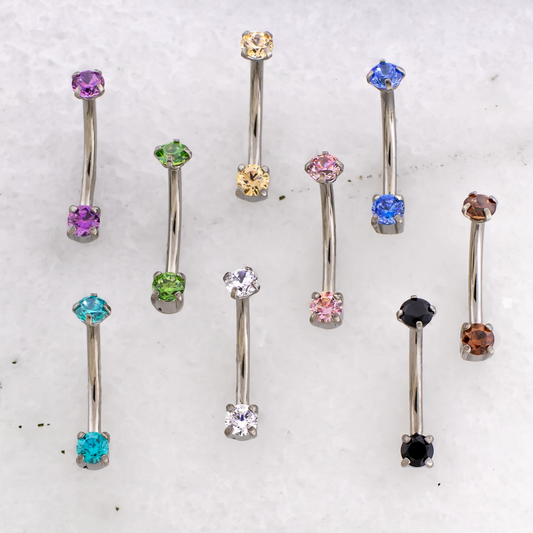
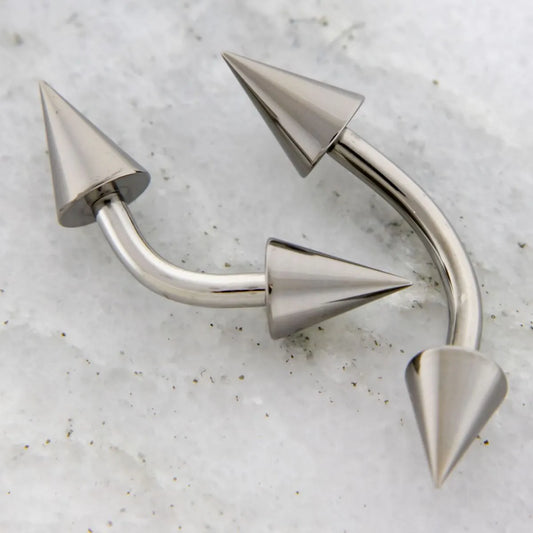
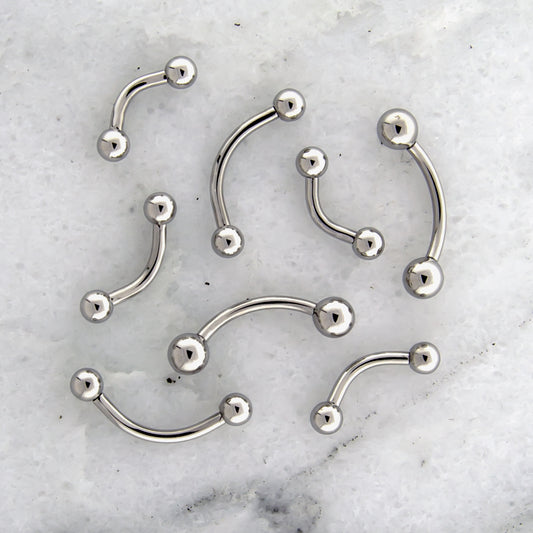
This collection features steel internally threaded curved barbells by Metal Mafia, made from 316L implant-grade steel with a mirror-polished finish and a precision-machined curve. Designed for placements where anatomy demands a curved fit: eyebrow, rook, navel, daith, and vertical labret. These barbells follow the natural contour of the tissue rather than working against it. Available in 14G and 16G across multiple lengths. Free shipping on orders over $25.
What Are Steel Internally Threaded Curved Barbells?
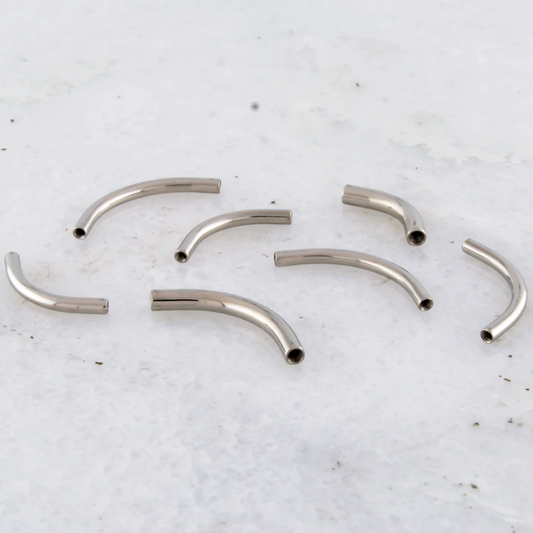
Steel internally threaded curved barbells are body jewelry posts with a gentle arc built into the shaft, designed to follow the natural curve of the body rather than running straight through tissue. The curve is what distinguishes them from straight barbells and circular horseshoe barbells. Where a straight barbell runs in a single direction, a curved barbell bends to accommodate the specific angle of certain piercing placements.
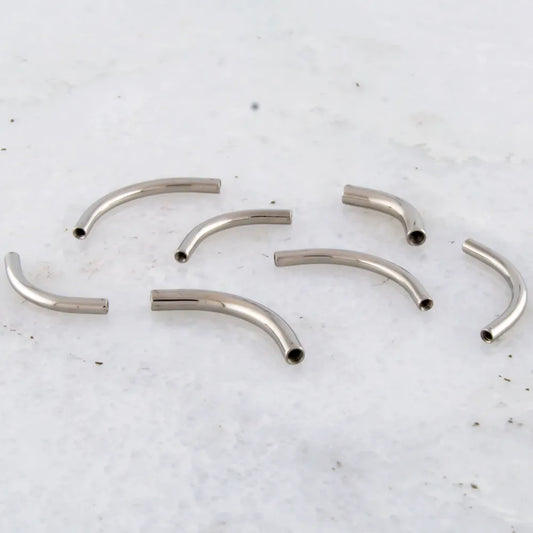
The internally threaded construction means the post shaft is completely smooth from end to end. Thread grooves sit inside the hollow tip of the post, and the ball or decorative end carries the screw pin that turns in to lock it in place. No threads are ever exposed on the shaft surface, which is what makes the smooth post safe to slide through a piercing channel without catching or dragging against tissue.
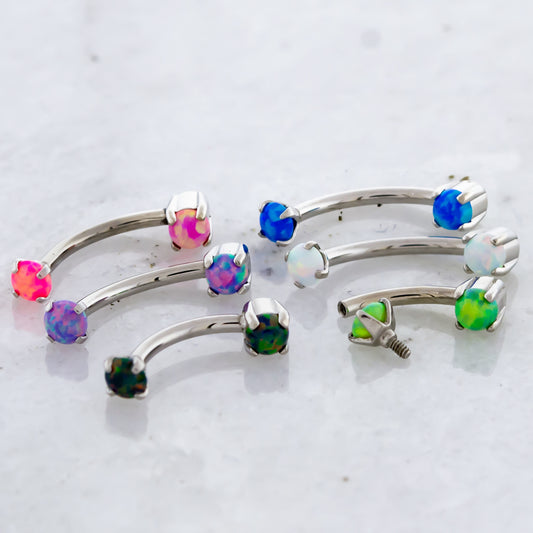
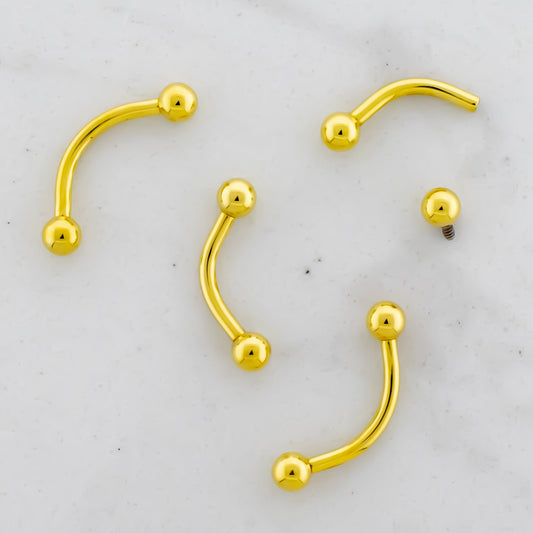
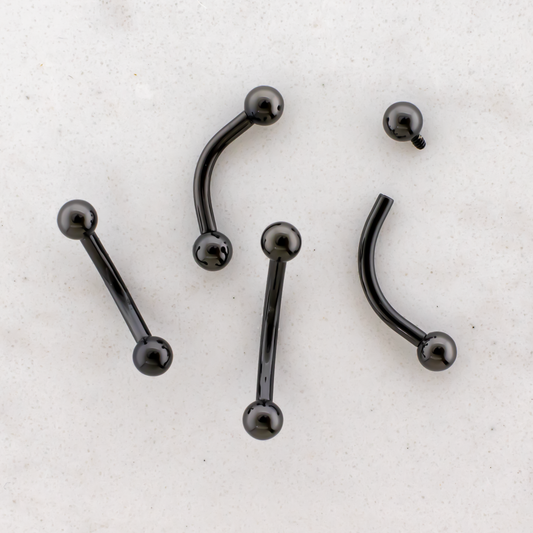
These steel internally threaded curved barbells are sold as complete pieces with ball ends included. The balls unscrew from one end, allowing for style swaps using compatible internally threaded ends without removing the barbell shaft from the piercing.
Why the Curve Matters for Certain Piercings
The shape of a curved barbell is not a stylistic choice. For placements like the eyebrow, rook, and navel, the curve is anatomically necessary. An eyebrow piercing passes through the skin along the brow ridge, which follows a natural arc. A straight barbell in this placement creates two pressure points at the entry and exit holes, pulling outward against the skin. Over time this pressure contributes to migration, where the body gradually pushes the jewelry toward the surface, and eventually rejection. A curved barbell distributes tension more evenly along the arc and sits flush against the brow without creating that outward pull.
The same logic applies to navel piercings, where a steel internally threaded curved barbell follows the tissue at the rim of the belly button, and rook piercings, which pass through the anti-helix fold of the ear. Both placements follow a curve that a straight barbell cannot accommodate without stress on the exit points. Using a steel internally threaded curved barbell in these placements is not a preference but the anatomically correct choice.
Internally Threaded vs Externally Threaded Curved Barbells
On an externally threaded curved barbell, thread ridges run along the outside of the post tip. On a steel internally threaded curved barbell, those ridges are contained inside the hollow post. When the barbell is inserted or removed, those ridges pass through the piercing channel and make contact with the tissue. In a healed and healthy piercing this contact is tolerable, but it creates friction and can cause minor irritation over repeated jewelry changes. In a fresh piercing or one that is still sensitive, externally threaded jewelry can cause micro-tears in the channel lining that slow healing and increase the risk of bumps.
A steel internally threaded curved barbell eliminates that friction entirely. The post shaft is smooth from one end to the other, and the screw mechanism is contained inside the hollow post tip. Insertion and removal involve only smooth 316L steel moving through the channel, which is why internally threaded construction is the professional standard for cartilage and surface placements where the tissue is thinner and less forgiving than a lobe.
Which Piercings Use a Curved Barbell?
Not every piercing uses a steel internally threaded curved barbell. The shape is specific to placements where anatomy creates a natural arc and where a straight post would sit at an angle that puts stress on the exit holes. Understanding which placements require a curved barbell and which can use other styles is the first step in making sure you order the right piece.
Eyebrow Piercings
Eyebrow piercings are surface piercings along the brow ridge and one of the most common placements for a steel internally threaded curved barbell. The standard gauge in US professional studios is 16G. Initial jewelry is typically 3/8 inch (10mm) in length to allow for swelling in the first few weeks. Once healed, most people downsize to 5/16 inch (8mm), which sits closer to the skin and reduces the leverage that leads to migration. Ball size at the eyebrow is usually 3mm to 4mm. A larger ball creates unnecessary pressure on the entry point and can draw attention to migration that has already begun. The small ball sits flush without digging in.
Rook Piercings
The rook is the anti-helix fold in the upper inner ear. A steel internally threaded curved barbell is the standard jewelry choice for this placement because the arc of the barbell follows the fold. The tight, folded anatomy makes a curved barbell the natural fit because the arc of the barbell follows the fold rather than pushing against it. Rook piercings are pierced at 16G in most US studios. Length follows the same initial and healed sizing as eyebrow: 3/8 inch for fresh placements and 5/16 inch once healed. Internal threading is particularly important at the rook because the placement is difficult to access, and smooth insertion reduces the risk of disturbing the piercing channel during changes.
Navel Piercings
Navel piercings are the most common application for a steel internally threaded curved barbell among all placement types. The standard gauge for navel piercings in the US is 14G. Initial jewelry is typically 7/16 inch (11mm) in length to accommodate swelling at a placement that experiences movement throughout the day. Healed navels usually downsize to 3/8 inch (10mm). The top ball on a navel curved barbell is sized for visibility at the rim of the belly button. A 5mm to 8mm top ball provides presence at the entry point without overhanging the anatomy. The bottom ball is typically smaller at 4mm to 5mm and sits inside the navel.
Daith and Vertical Labret Piercings
Daith piercings pass through the innermost fold of the ear cartilage and can be worn with either a curved barbell or a circular barbell depending on anatomy and preference. When a steel internally threaded curved barbell is used at the daith, 16G is standard with a length of 5/16 inch to 3/8 inch. Vertical labret piercings pass through the lower lip from the top of the lip to the underside of the chin, following the curve of the lip. A steel internally threaded curved barbell at 16G with a length between 3/8 inch and 7/16 inch follows that curve cleanly and keeps both visible ends positioned correctly without shifting.
Choosing the Right Gauge and Length
Gauge and length are the two variables that determine whether a steel internally threaded curved barbell will fit your piercing. Gauge must match the diameter of your existing piercing channel exactly. Length is measured as a straight-line distance from end to end, not along the curve of the barbell. A barbell that is too long will sit loosely and snag on clothing. A barbell that is too short will press against the entry and exit holes and create pressure that slows healing or causes irritation in a healed piercing.
- Eyebrow: 16G | Initial 3/8" (10mm), healed 5/16" (8mm) | Ball size 3mm to 4mm
- Rook: 16G | Initial 3/8" (10mm), healed 5/16" (8mm) | Ball size 3mm to 4mm
- Navel: 14G | Initial 7/16" (11mm), healed 3/8" (10mm) | Top ball 5mm to 8mm
- Daith: 16G | Initial 3/8" (10mm), healed 5/16" (8mm) | Ball size 3mm to 4mm
- Vertical Labret: 16G | Initial 7/16" (11mm), healed 3/8" (10mm) | Ball size 3mm to 4mm
Length on a steel internally threaded curved barbell is measured as a straight line from end to end, not along the curve of the shaft. Initial piercings always require a longer barbell to accommodate swelling in the first several weeks. Downsizing to the healed length is done at a studio, typically between six and ten weeks after the piercing. Skipping the downsize and leaving a long initial barbell in a healed piercing increases the risk of snagging and slows the final stages of healing.
Why 316L Steel for a Curved Barbell?
316L surgical steel is the material used in every steel internally threaded curved barbell in this collection. For steel internally threaded curved barbells in fully healed piercings, it delivers reliable performance at a lower price point than ASTM F136 titanium or solid gold. The material is formulated to minimize nickel release, is resistant to corrosion, and takes a mirror polish that holds up well to regular wear and cleaning.
The precision-machined curve on each steel internally threaded curved barbell holds its shape through repeated wear and cleaning without warping or flattening. This matters particularly for eyebrow and rook piercings where even a subtle change in barbell geometry can shift the pressure points and cause irritation in a placement that had been healing without issue.
One important note on material selection: for a fresh piercing that is still in the healing process, ASTM F136 implant-grade titanium offers superior biocompatibility and is the professional recommendation. Steel internally threaded curved barbells in 316L are best suited for fully healed piercings where you are replacing existing jewelry or upgrading a healed placement.
For titanium options in the same curved barbell format, see our Internally Threaded Curved Barbells collection by Khrysos Jewelry.
Why Shop Steel Internally Threaded Curved Barbells at Pierced Addiction?
Every steel internally threaded curved barbell at Pierced Addiction is sourced from Metal Mafia, a supplier that builds to professional piercing industry tolerances. The 316L steel is solid throughout with no plating over base metal. Every steel internally threaded curved barbell in this collection has a precision-machined curve that is consistent across pieces, so the fit is reliable every time.
- 316L implant-grade steel, solid construction with no plating, consistent curve geometry across all pieces
- Precision internal threading, smooth post shaft with thread grooves inside the tip only, compatible with standard internally threaded ends
- Multiple gauges and lengths, 14G and 16G available across a range of lengths to cover eyebrow, rook, navel, daith, and vertical labret placements
- Free USPS economy shipping on all orders over $25, all orders fully insured
- Same-day processing for domestic orders received before 1PM
- 7-day quality guarantee on all items in original sealed packaging
If you need to swap ends on your barbell, browse our Steel Internally Threaded Ends collection for compatible screw-in tops in CZ, opal, flat disc, and shaped styles at matching gauges.
Frequently Asked Questions
What gauge do I need for an eyebrow curved barbell?
16G is the standard gauge for eyebrow piercings in US professional studios. If you are replacing existing jewelry, match the gauge of your current barbell exactly.
What is the standard length for a navel curved barbell?
Initial navel piercings use 7/16 inch (11mm) to allow room for swelling. Fully healed navels typically downsize to 3/8 inch (10mm). Have your piercer confirm the correct length before ordering.
Can I use a 316L steel curved barbell for a fresh piercing?
316L is implant-grade but ASTM F136 titanium is the stronger recommendation for fresh piercings. Steel internally threaded curved barbells in 316L are best suited for fully healed placements.
What is the difference between a curved barbell and a circular barbell?
A curved barbell has a fixed arc and two ends. A circular barbell is horseshoe-shaped and open at one end. Curved barbells suit eyebrow, rook, and navel. Circular barbells suit septum and orbital placements.
Are the ends on these barbells compatible with internally threaded ends sold separately?
Yes. The ball ends on these barbells unscrew and can be replaced with any compatible internally threaded ends at the matching gauge. This allows you to change the look without removing the barbell from the piercing.
How do I know if I need a 14G or 16G curved barbell?
14G is standard for navel piercings. 16G is standard for eyebrow, rook, daith, and vertical labret. If replacing existing jewelry, check the gauge printed on the original packaging or ask your piercer to confirm.
Shop Steel Internally Threaded Curved Barbells
Steel internally threaded curved barbells are the anatomically correct choice for eyebrow, rook, navel, daith, and vertical labret piercings. This collection covers 14G and 16G in multiple lengths, all 316L implant-grade from Metal Mafia. If you need a straight post instead, see our Steel Internally Threaded Straight Barbells. Browse the collection above and find your fit. Free shipping on orders over $25.