Piercing Aftercare Solution: Saline Sprays, Wound Wash & Bump Treatments
The right piercing aftercare solution supports clean, consistent healing from the first day after piercing through the full healing period. This piercing aftercare solution collection covers sterile saline sprays, wound wash, aftercare wipes, and keloid bump treatments for all piercing types, from fresh lobe piercings to cartilage placements in active healing.
Aftercare note: Piercing aftercare solution products in this collection support the healing process for new and established piercings. If you experience significant swelling, discharge with odor, spreading redness, or fever following a piercing, consult a healthcare provider promptly.
Why the Right Piercing Aftercare Solution Matters
A new piercing is an open wound channel passing through live tissue. The piercing aftercare solution products you apply to that channel during the weeks and months of healing directly affect how quickly the channel matures, how much irritation occurs, and whether complications like bumps or prolonged soreness develop. Choosing a piercing aftercare solution formulated specifically for this purpose is not a preference decision; it is the single most controllable factor in how well a piercing heals.
What Sterile Saline Actually Does
The standard for piercing aftercare solution recommended by the Association of Professional Piercers (APP) is a sterile saline solution at 0.9% sodium chloride with no additives. This concentration is isotonic, meaning it matches the osmolarity of human tissue fluid. When you apply an isotonic saline solution to a healing piercing, it loosens and removes dried discharge and debris from the entry and exit points without creating osmotic stress on the surrounding cells. It cleans the surface of the piercing channel without burning, without disrupting the cellular repair process underway in the tissue, and without introducing chemical compounds that the immune response must then manage alongside healing.
What to Avoid in Piercing Aftercare
The most common mistakes in piercing aftercare involve applying products that actively disrupt healing tissue. The following should not be used on a healing piercing regardless of how they are marketed:
- Hydrogen peroxide: Breaks down healthy tissue cells and new granulation tissue forming in the piercing channel. The foaming effect is the result of cell damage, not cleaning action.
- Rubbing alcohol: Denatures proteins and kills cells indiscriminately, including the cells actively building the healing channel. Causes dryness and microfissures in surrounding skin.
- Antibacterial soaps with fragrance: Fragrance compounds and antibacterial agents like triclosan irritate healing tissue and disrupt the microbiome balance around the piercing.
- Bactine and similar wound sprays: Contain lidocaine and benzalkonium chloride, both of which slow the healing process in a piercing channel rather than supporting it.
The APP specifically recommends against all of these for piercing aftercare and has done so consistently for decades based on member piercer experience and dermatological evidence.
Types of Piercing Aftercare Products
Not every piercing aftercare solution product serves the same purpose. Matching the product type to your situation and healing stage produces better outcomes than using a single product indiscriminately throughout the entire healing period.
Sterile Saline Spray
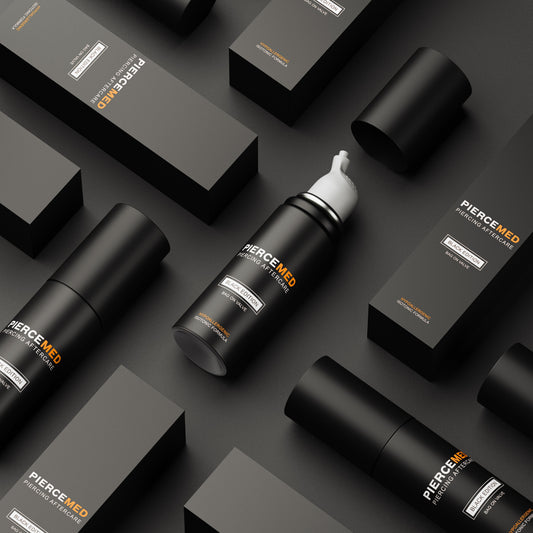
A sterile saline spray in a pressurized can delivers a fine mist of 0.9% sodium chloride solution directly to the piercing site without requiring you to touch the piercing or use a separate applicator. This delivery method is the most practical for daily aftercare because it minimizes contact with the healing channel, reduces the risk of transferring bacteria from hands to the piercing, and reaches both the entry and exit points of the piercing simultaneously.
Sterile saline sprays are the primary piercing aftercare solution recommended by the APP for all piercing types. The key specifications to look for in any piercing aftercare solution are: sterile (not just purified), 0.9% sodium chloride concentration, no preservatives, and no additives beyond the saline formula. Products like NeilMed Piercing Aftercare Fine Mist and H2Ocean meet these criteria and are carried in this collection specifically because they align with APP aftercare standards.
Wound Wash and Saline Soak
A sterile wound wash uses the same 0.9% saline formula as a spray but is dispensed as a stream rather than a mist, allowing you to irrigate the piercing channel or soak a specific placement. This format is particularly useful for navel piercings, where a full cup soak allows the saline to reach all surfaces of the piercing simultaneously, and for stretched piercings where the larger channel benefits from thorough irrigation.
A saline soak is done by filling a small cup with warm sterile saline and submerging the piercing for two to five minutes. This is an alternative to spray application rather than a daily replacement and is most useful when a piercing is feeling particularly sore or showing signs of irritation.
Piercing Aftercare Wipes
Pre-moistened saline wipes provide a single-use, travel-friendly alternative to spray bottles for on-the-go cleaning. They are most useful as a supplement to a primary spray routine rather than a daily replacement, particularly for wiping away dried discharge or cleaning around the jewelry without saturating the area. Wipes are a practical addition to a bag or kit when traveling and do not require the pressure or storage considerations of a spray can.
Keloid Bump Treatment and Bump Oil
Bump treatment products are formulated specifically for the irritation bumps and keloid-type bumps that can form alongside a healing piercing. These are separate from standard saline aftercare spray and are applied directly to the bump as a spot treatment rather than used for general cleaning. Most bump treatment products in this collection use a concentrated saline base, tea tree oil derivatives, or botanical extracts at low concentrations to reduce the inflammation and irritation driving bump formation.
Bump treatment products are appropriate for use alongside your regular saline spray routine, not instead of it. They address the symptom while standard aftercare supports the continued healing of the piercing channel itself.
See more: Piercing Blog - Healing & Aftercare Guides
How to Use Piercing Aftercare Solution
Having the right piercing aftercare solution produces no benefit if the application routine is inconsistent or incorrect. The technique used to apply aftercare matters as much as the product itself.
Daily Cleaning Routine for New Piercings
For a new piercing in the first weeks and months of healing, the standard aftercare routine recommended by the APP is two applications of sterile piercing aftercare solution per day: once in the morning and once in the evening.
To apply: hold the spray can a few inches from the piercing and spray directly onto both the entry and exit points of the jewelry. Allow the saline to sit on the piercing for a few seconds to loosen any crusted discharge. If crusting is present around the jewelry, allow it to soften with the saline rather than picking or forcibly removing it. Do not rotate or twist the jewelry during or after cleaning. Let the piercing air dry, or gently pat it dry with a clean paper towel. Do not use cloth towels, which can harbor bacteria and snag on jewelry.
Do not clean more than twice daily. Over-cleaning with saline can dry out the surrounding skin and slow healing by disrupting the moisture balance at the piercing site.
How Often to Use Aftercare as Healing Progresses
Aftercare frequency should decrease as the piercing matures. The appropriate schedule through a standard healing period follows a general pattern:
- Weeks one through four: Two applications of sterile saline spray per day. This is the period of acute healing where cleaning consistency matters most.
- Months two and three: Continue at two applications daily or reduce to once daily if the piercing is showing consistent improvement with no discharge or soreness.
- Months four through six: Once daily or as needed based on how the piercing is feeling. Healthy cartilage piercings often still benefit from once-daily cleaning at this stage.
- Month six and beyond: As needed for comfort. A fully healed piercing does not require daily aftercare but benefits from occasional cleaning if irritated after jewelry changes or extended wear.
Aftercare for Specific Piercing Types
Cartilage piercings (helix, tragus, conch, rook, daith) take significantly longer to heal than lobe piercings due to lower blood supply in cartilage tissue. Consistent saline aftercare throughout the full healing period is more important for cartilage than for any other placement.
Oral piercings (tongue, lip, cheek) require an oral-specific aftercare rinse in addition to external saline spray. Alcohol-free antibacterial mouthwash diluted with water is the standard recommendation for internal oral aftercare. The external entry and exit points of lip piercings are treated with standard sterile saline spray.
Navel piercings benefit from saline soaks in addition to spray application because the curved barbell sits at a bend in the body that experiences movement and clothing friction constantly. Saline soaks allow the piercing to rest in the solution without mechanical interference.
See more: Titanium Piercing Jewelry
Healing Timeline and Aftercare by Stage
Understanding where your piercing is in the healing process helps you use your piercing aftercare solution appropriately and set realistic expectations for what healing looks and feels like.
- Acute healing (Days 1 to 14): Expect swelling, tenderness, and some clear or white discharge. Clean twice daily with sterile saline spray.
- Transition (Weeks 2 to 8): Swelling reduces, discharge becomes minimal, occasional crusting may appear. Continue twice daily cleaning.
- Establishing (Months 2 to 6): Occasional crusting with no active discharge and reduced tenderness. Reduce to once daily aftercare.
- Maturing (Months 6 to 12): No discharge, no regular tenderness, some crusting still possible. Once daily or as needed.
- Healed (12 months and beyond for cartilage): No discharge, no tenderness, fully comfortable under normal wear. Use aftercare as needed after jewelry changes only.
The timeline above reflects typical healing for most cartilage and body piercings. Lobe piercings often progress through these stages faster, with full healing possible at three to six months for standard placements. Cartilage and body piercings consistently take longer and should not be considered healed until all discharge has fully stopped and the piercing is completely comfortable under normal daily movement.
Progressing through healing stages does not mean stopping aftercare prematurely. Many people stop using their piercing aftercare solution when the piercing looks healed from the outside while the internal channel is still maturing. The piercing should feel healed, not just look healed, before aftercare is discontinued.
Do not rush the healing process. Cartilage piercings in particular take longer than they appear to. A piercing that looks healed on the surface may still have an immature channel internally that needs continued support.
Treating Piercing Bumps with Aftercare Solution
Piercing bumps are the most common complication that brings people back to search for piercing aftercare solutions after their initial setup. Understanding what type of bump you are dealing with determines the most effective response.
Irritation Bump vs. Keloid: Know the Difference
An irritation bump is a small raised area of inflamed tissue that forms alongside a healing piercing when the piercing has been subjected to repeated trauma, pressure, or the wrong jewelry material. Irritation bumps are temporary and typically resolve within two to six weeks when the source of irritation is removed and consistent saline aftercare is maintained. Common causes include sleeping on cartilage piercings, clothing friction on navel or surface piercings, jewelry that is too short for the placement, or low-quality jewelry material triggering a reaction.
A true keloid is an overgrowth of scar tissue that extends beyond the original wound margin. Keloids are genetically predisposed, disproportionate in size to the original piercing, and do not resolve on their own with aftercare products. Keloids require medical evaluation and treatment. The vast majority of piercing bumps that people describe as keloids are actually irritation bumps and do respond to correct aftercare and jewelry changes.
How Bump Treatment Products Support Healing
Bump treatment piercing aftercare solution products in this collection are formulated to reduce the inflammation and irritation that drives bump formation rather than to treat the piercing channel itself. Applied directly to the bump as a spot treatment alongside your standard saline spray routine, these products help calm the reactive tissue while the underlying cause is addressed. Bump treatment is most effective when combined with identifying and removing the irritation source, whether that means changing to implant-grade jewelry material, adjusting sleeping position, or loosening clothing that presses against the piercing.
If a bump persists for more than six weeks despite correct aftercare and jewelry changes, consult your piercer for an in-person assessment before continuing to self-treat.
Why Shop Aftercare at Pierced Addiction?
Pierced Addiction carries piercing aftercare solutions that align with the standards set by the Association of Professional Piercers, the professional body that establishes evidence-based protocols for piercing care in the United States.
APP-aligned products only. Every piercing aftercare solution in this collection is selected for compatibility with APP aftercare guidelines. No alcohol-based products, no products with additives that disrupt healing tissue.
Sterile and preservative-free options. Preservative-free sterile saline spray is the APP's first-choice recommendation. This collection prioritizes products meeting that specification.
Full product range across healing stages. Saline spray for daily use, wound wash for soaking, aftercare wipes for travel, and bump treatment for spot care are all available in one collection rather than requiring multiple retailers.
Bundled with jewelry orders. Adding a piercing aftercare solution to a jewelry order covers the full setup in a single transaction.
Free domestic shipping and same-day processing. Orders over $25 ship free via USPS economy. Domestic orders placed before 1pm are processed the same day.
Frequently Asked Questions
Find quick answers to the most common questions about piercing aftercare solutions, application frequency, and treating complications.
What is the best piercing aftercare solution?
The APP recommends sterile saline spray at 0.9% sodium chloride with no additives as the standard for all piercing types. NeilMed Piercing Aftercare Fine Mist and H2Ocean are widely used options that meet this standard. Preservative-free formulas are preferred.
How many times a day should I use piercing aftercare spray?
Twice daily for new piercings through the first several months of healing. Reduce to once daily as the piercing matures and discharge resolves. Do not clean more than twice daily as over-cleaning can dry out surrounding skin and slow healing.
Can I use NeilMed wound wash as piercing aftercare?
Yes. NeilMed Wound Wash is the same sterile 0.9% saline formula as their piercing aftercare product and is widely used by professional piercers for the same purpose. Both are sterile, preservative-free, and isotonic.
What causes piercing bumps and how do I treat them?
Most piercing bumps are irritation bumps caused by pressure, trauma, wrong jewelry material, or jewelry that is too short for the placement. Consistent saline aftercare combined with removing the irritation source resolves most irritation bumps within two to six weeks.
Do I still need aftercare on a fully healed piercing?
A fully healed piercing does not need daily aftercare. However, sterile saline spray is useful after jewelry changes, following any accidental trauma to the piercing, or whenever the piercing feels irritated.
Consistent use of the right piercing aftercare solution from day one through full healing is the most effective thing you can do to support a complication-free result. Shop the full piercing aftercare solution collection above to find your product. Shop the full range above to find the spray, wash, or bump treatment that matches your piercing and your healing stage.