Nose Bridge Piercing Barbells – Implant-Grade Titanium for Surface Piercings
A nose bridge piercing is one of the boldest facial piercings you can wear, and it demands jewelry that performs as well as it looks. Our collection of nose bridge piercing barbells is made from ASTM F136 implant-grade titanium by Khrysos Jewelry, the material standard professional piercers trust for surface piercings. Whether you are freshly pierced or upgrading a healed bridge, find your fit here.
What Is a Nose Bridge Piercing?
Before choosing your jewelry, it helps to understand what makes this piercing different from other nose piercings and why that changes what you should buy.
A nose bridge piercing, also known as an Erl piercing, is a horizontal surface piercing that sits across the bridge of the nose at the narrowest point between the eyes. It is one of the most visually striking facial piercings available, creating a symmetrical bar effect that draws attention to the eyes and upper face. Unlike a nostril piercing that goes through soft cartilage, or a septum piercing that passes through the tissue between the nostrils, a bridge piercing travels through a thin fold of skin on the surface of the nose. This is what makes it a surface piercing, and that classification comes with specific implications for how you need to care for it and, critically, what jewelry you should wear.
Surface piercings as a category carry a higher risk of rejection and migration than piercings that go through more substantial tissue. The body can sometimes treat surface jewelry as a foreign object and gradually push it toward the skin surface over time. This is not inevitable, and many people wear bridge piercings for years without complications, but it does mean that every decision around placement, aftercare, and jewelry quality carries more weight here than it would for a nostril or lobe piercing.
See more: Nose Bridge Piercing: Pain, Cost, Healing, and Jewelry Placement Guide
Why Material Choice Matters More for Bridge Piercings
For a surface piercing, the material touching your tissue is not just a quality preference. It directly affects your healing timeline and long-term outcome.
ASTM F136 implant-grade titanium is the professional standard for nose bridge piercing jewelry, and the reasons go beyond marketing language. This specific grade of titanium is 100% nickel-free, which is critical because nickel sensitivity is far more common than most people realize, and even a mild reaction in healing tissue can trigger chronic inflammation that looks identical to a rejection response. Ruling out metal sensitivity with a biocompatible material from the start removes one of the most common causes of bridge piercing complications.
Titanium is also significantly lighter than steel. That weight difference matters more for surface piercings than for other placements because surface piercings sit under a very thin layer of skin with minimal tissue support on either side. Extra weight means extra gravitational pull on the entry and exit points, which over time creates the kind of low-grade, constant pressure that encourages migration. Lighter jewelry simply puts less mechanical stress on a healing surface piercing.
Finally, ASTM F136 titanium has no plating, no coatings, and no surface finishes that can break down inside a healing piercing channel. What you see is the material itself, anodized at the molecular level rather than coated on top. For a piercing that may take several months to fully heal, that consistency matters.
Steel is biocompatible and perfectly appropriate for healed piercings, but for a healing bridge piercing, titanium is the choice that professional piercers recommend consistently. All nose bridge piercing barbells in our collection meet the ASTM F136 standard.
Explore our full Titanium Nose Jewelry collection for more implant-grade options.
Straight Barbell vs. Curved Barbell: Which Is Right for Your Bridge Piercing?
This is one of the most common questions before buying, and the answer depends more on your anatomy and healing stage than on personal style preference.
Straight Barbells
A straight barbell sits flat and horizontal across the bridge of the nose, creating a clean, symmetrical look with the ends sitting evenly on both sides. For fully healed bridge piercings on relatively flat nose bridge anatomy, a straight barbell is a strong choice. It is minimal, versatile, and easy to pair with other facial jewelry. The limitation is that a perfectly rigid straight bar on a bridge with natural curvature can put uneven pressure on the entry and exit points of the piercing. On a healing piercing, that uneven pressure is something you want to avoid.
Curved Barbells
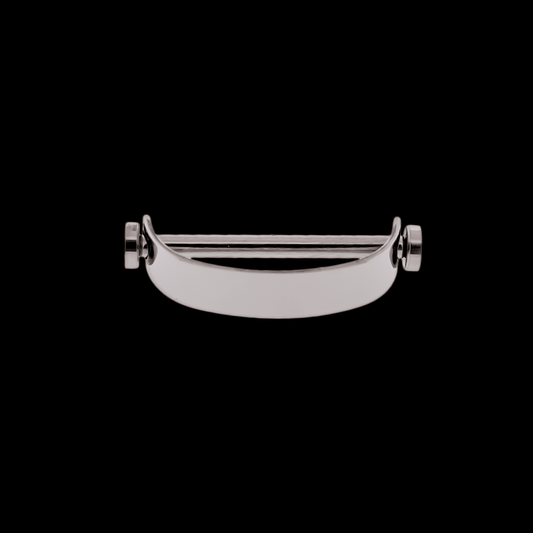
A curved barbell has a subtle banana-shaped bend that allows the jewelry to follow the natural contour of the nose bridge rather than fighting against it. Many professional piercers prefer to start bridge piercings with a curved barbell precisely because this flexibility reduces tension at the piercing points during the healing phase. If you were initially pierced with a curved bar, staying with that style through your full healing period is generally the right call. Switching to a straight bar mid-heal can introduce new pressure dynamics that disrupt the healing channel.
The practical takeaway: for a fresh or healing nose bridge piercing, a curved barbell is usually the safer and more comfortable starting point. For a fully healed piercing on flatter bridge anatomy, a straight barbell delivers a sharper, more graphic look. When in doubt, ask your piercer which style they recommend based on your specific anatomy.
How to Choose the Right Gauge and Length
Sizing errors are more consequential with bridge piercings than with most other placements. Here is what to know before you order.
Gauge
16G (1.2mm) is the professional standard for the majority of nose bridge piercings performed in the US. Some piercers work at 14G depending on individual anatomy and the look they are going for, but 16G is the most common starting point. If you are replacing an existing barbell, check the gauge of your current jewelry before ordering. Wearing jewelry at a different gauge than your piercing channel can cause tearing or embedding, both of which are serious complications for a surface piercing.
Length
Bridge barbell length is highly individual and depends on the physical width of your nose bridge. Most bridge piercings fall somewhere in the 10mm to 16mm range, but the right length for you is whatever your piercer measured at the time of your piercing. For a fresh piercing, your piercer will fit you with a longer bar than your final resting size to allow room for swelling during the initial healing phase. Once that swelling subsides, downsizing to a shorter bar is an important step because excess bar length increases the risk of snagging and catching on clothing, towels, or pillowcases, all of which can irritate the piercing and prolong healing.
Do not attempt your first downsize on your own. Have your piercer do it. They can confirm your piercing is ready, select the correct length, and perform the change with minimal trauma to the healing tissue.
Shop Nose Bridge Piercing Barbells
Every piece in this collection is made from ASTM F136 implant-grade titanium by Khrysos Jewelry, sourced to meet the material standards used in professional piercing studios.
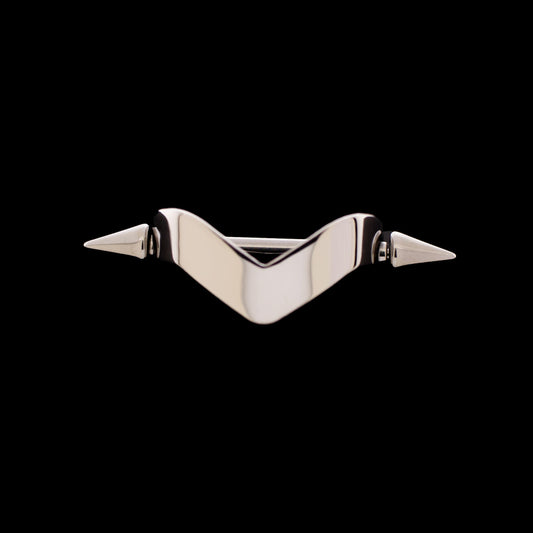
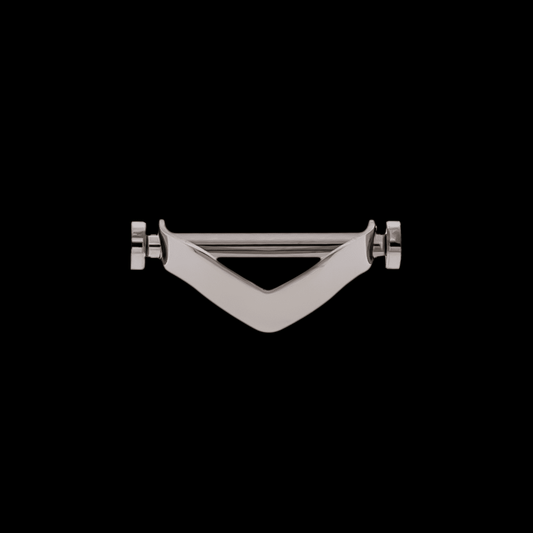
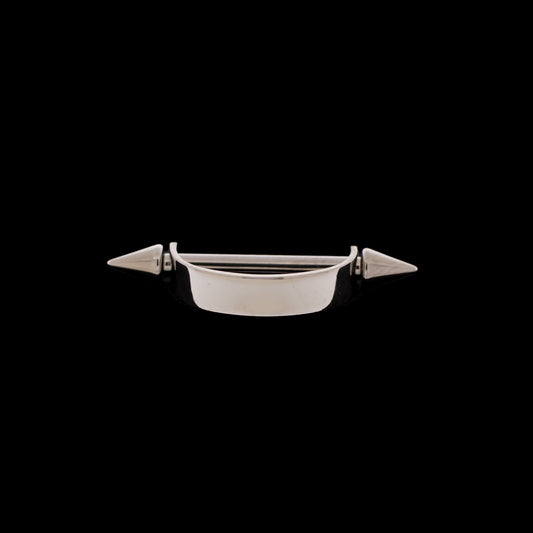
14G V-Shape Nose Bridge Cuff with Spike Ends
The V-shape cuff is the most architecturally distinctive piece in the collection. Rather than a flat horizontal bar, the V design angles the jewelry so it follows the contour of the nose bridge in a pointed, geometric shape. The spike ends face outward from each side of the piercing, creating an edgy, angular look that reads as bold without being excessive. Made from ASTM F136 implant-grade titanium at 14G with internally threaded ends for smooth, low-trauma jewelry changes. This one is best suited for fully healed bridge piercings where you are ready to make a real style statement.
See detail: 14G V-Shape Nose Bridge Cuff with Spike Ends
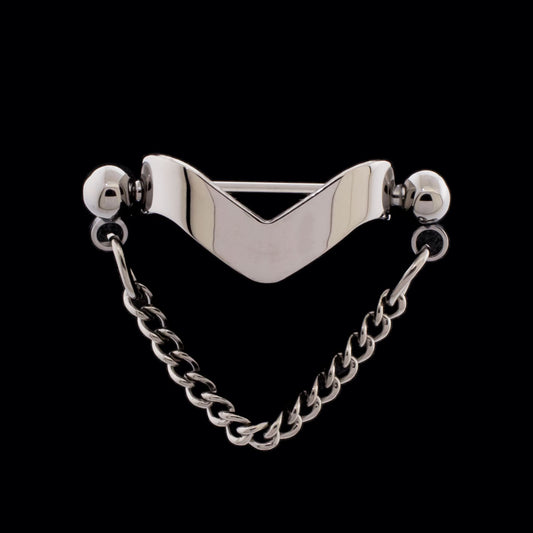
Threadless Nose Bridge V-Cuff with Curb Chain
This piece takes the V-cuff profile and adds a delicate curb chain that drapes across or below the bridge, creating a layered, multidimensional look. The chain adds movement and detail without overwhelming the face. The threadless push-fit system makes swapping ends straightforward and minimizes trauma during changes, which is a meaningful advantage for a surface piercing where repeated rough jewelry changes can accelerate rejection. Built from implant-grade titanium throughout, it pairs naturally with other face jewelry for a curated piercing setup.
See detail: Threadless Nose Bridge V-Cuff with Curb Chain
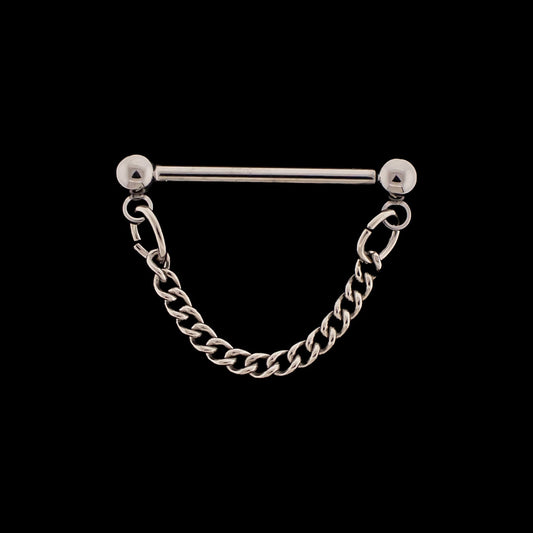
Threadless Nose Bridge Barbell with Curb Chain
A cleaner, more wearable take on the chained bridge look. This threadless straight barbell sits horizontally across the bridge with a curb chain element that adds dimension without the angular V-shape. If you want the chain detail but prefer a more conventional barbell profile, this is the piece. It pairs well with nostril studs, septum rings, or eyebrow piercings for a cohesive facial piercing look. Threadless fit, implant-grade titanium, designed for healed bridge piercings.
See detail: Threadless Nose Bridge Barbell with Curb Chain
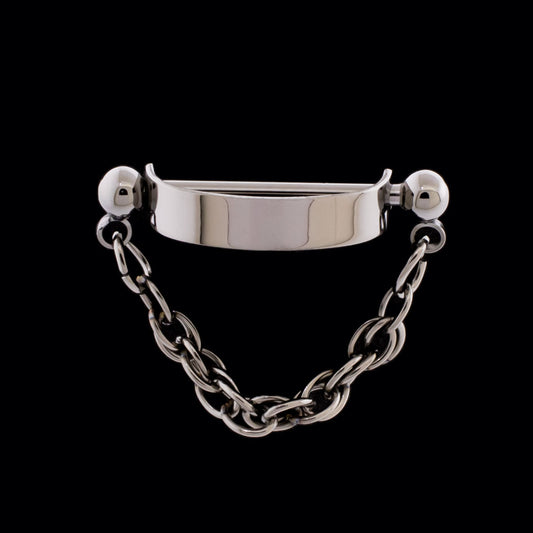
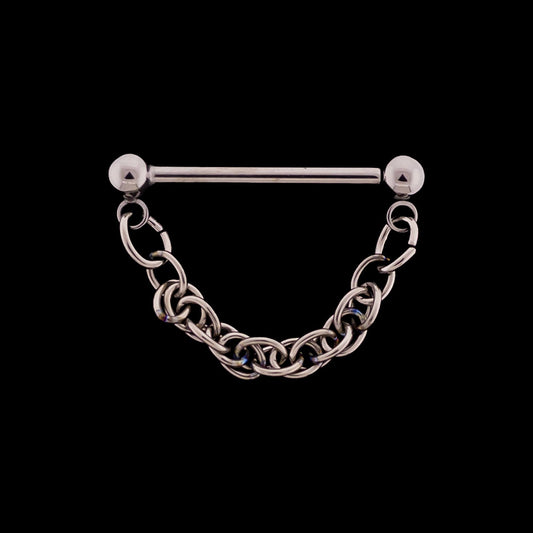
Threadless Nose Bridge Cuff with Rope Chain
The rope chain version offers the same chained-bridge concept with a different chain texture. Where the curb chain has flat, uniform links, the rope chain has a twisted, helical structure that catches light more dynamically and reads as slightly more intricate up close. For people who like their jewelry to reward a second look, this is the pick. Same implant-grade titanium construction, same threadless fit, same commitment to material quality.
See detail: Threadless Nose Bridge Cuff with Rope Chain
Why Shop Nose Bridge Jewelry at Pierced Addiction?
There are real differences between body jewelry brands, and for a surface piercing like the bridge, those differences have real consequences.
Every nose bridge barbell in this collection comes from Khrysos Jewelry, a professional-grade brand whose pieces are stocked by piercing studios, not just assembled for e-commerce. We carry only implant-grade titanium in this category because for a surface piercing, substandard jewelry is one of the most reliable paths to rejection, migration, and scarring. We do not think a few dollars of savings is worth that risk, and neither should you.
Our nose bridge collection includes both internally threaded and threadless designs. Both systems eliminate the exposed threading problem that makes externally threaded jewelry a poor fit for surface piercings. With externally threaded jewelry, rough metal threads make contact with the piercing channel every time the jewelry is inserted or removed. For a surface piercing that is already more vulnerable than most, that repeated micro-trauma adds up. Internally threaded and threadless designs both ensure a smooth post passes through the piercing with no thread contact, which protects the tissue and supports long-term piercing health.
Free USPS economy shipping on all orders over $25, plus a clearance section with 40% off select styles reflected at checkout. Professional-grade jewelry does not have to come with studio pricing.
Browse our Internally Threaded Curved Barbells for additional titanium options suited to bridge and other surface piercings.
Frequently Asked Questions About Nose Bridge Piercings
The most common questions we hear from people shopping for nose bridge jewelry.
What is the best material for a nose bridge piercing?
ASTM F136 implant-grade titanium. It is 100% nickel-free, lightweight, and biocompatible, which directly reduces rejection risk for surface piercings.
Is a nose bridge piercing a surface piercing?
Yes. It passes through a thin fold of skin on the nose bridge, not through cartilage or bone. This makes material quality and jewelry fit more important than with most other piercings.
What gauge is standard for a bridge piercing?
16G (1.2mm) is the most common professional standard in the US. Always confirm with your piercer before ordering a replacement barbell.
Can I wear glasses with a nose bridge piercing?
Yes, but standard frames may rest directly on the piercing site and cause pressure during healing. Switching to contacts or adjusting nose pads to avoid contact with the piercing is strongly recommended during the healing phase.
How long does a nose bridge piercing take to heal?
Most bridge piercings heal in 8 to 12 weeks with consistent saline aftercare. Because it is a surface piercing, healing requires more attention to avoid migration or rejection than a standard nose piercing would.
When can I safely change my nose bridge jewelry?
Wait until the piercing is fully healed, typically a minimum of 8 to 12 weeks. Have a professional piercer perform the first jewelry change to avoid traumatizing the healing tissue during what can be a delicate transition.
Conclusion
A nose bridge piercing rewards you for getting the details right. The right material, the right barbell style, and the right size all contribute directly to how long you enjoy the piercing without complications. Every piece in this collection is made from ASTM F136 implant-grade titanium, built for surface piercings, and sourced from a brand trusted by professional piercers. Free shipping on orders over $25. Shop the full collection above and find your fit.