

Steel Hinged Segment Rings: Clicker Rings in 316L Implant-Grade Steel
Steel hinged segment rings bring the easiest jewelry change experience of any ring style to your healed piercings. A single click opens the ring, a single click closes it, and the 316L implant-grade steel holds its finish through daily wear. This collection spans 20G through 10G in plain high-polish, PVD-coated, and decorative styles for septum, daith, helix, nose, and cartilage placements.
What Is a Steel Hinged Segment Ring?
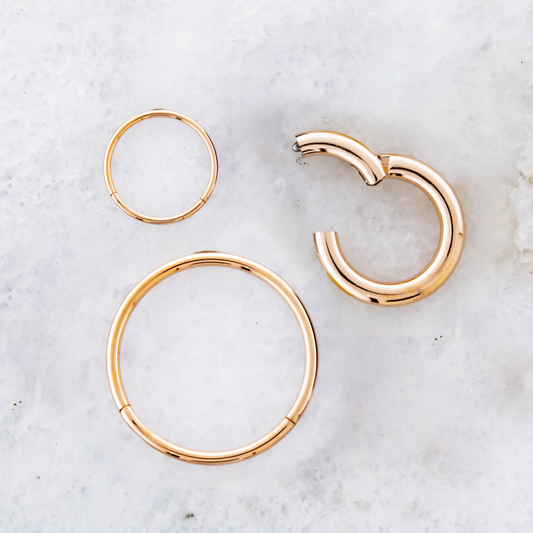
A steel hinged segment ring is a circular ring that opens and closes through a small hinged latch built into the ring body. One section of the ring pivots open on a hinge, and a precision latch on the opposite side clicks shut to seal the ring. The result is a ring that looks like a seamless continuous hoop from the outside but opens and closes without tools, without bending, and without the friction of a captive ball. The 316L implant-grade steel construction maintains the structural integrity of the hinge mechanism over repeated use while keeping the ring surface safe against piercing tissue.
Hinged Segment Ring vs. Clicker Ring: Same Thing?
Yes. Hinged segment ring and clicker ring describe the same jewelry. The term "clicker" comes from the audible or tactile click the latch makes when the ring closes securely. "Hinged segment ring" is the more technical name used in professional piercing contexts. Both terms appear across product listings and piercing studio inventories interchangeably, and both refer to the same hinged latch mechanism. If your piercer has recommended a clicker for your septum or daith, a steel hinged segment ring is what they mean.
How to Open and Close a Hinged Segment Ring
The hinged mechanism is simple once you understand how it works, but the first attempt often feels awkward. Locate the hinge point on one side of the ring and the latch on the opposite side. Hold the ring with the hinge between two fingers for stability. Press the latch section inward or downward depending on the design to disengage it, then swing the hinged segment open. Place the open ring against the piercing and guide the post through the channel. Align the open segment with the ring body and press it closed until you feel or hear the latch engage. A properly closed steel hinged segment ring will not flex or shift once latched.
Hinged Segment Ring vs. Captive Ring vs. Seamless Ring
All three are ring styles for body piercing, but they differ in how they open, how they look, and which placements they suit best.
Hinged Segment Ring (Clicker):
- Opens and closes via a built-in latch mechanism
- No separate ball or loose piece
- Easiest of the three types to insert and remove single-handed
- Suitable for septum, daith, helix, conch, and cartilage placements
Captive Bead Ring:
- Open ring held closed by a separate ball under tension
- Ball can be removed and swapped for different sizes
- Requires two hands or ring-opening pliers for changes
Seamless Ring:
- Continuous steel ring with a single cut that twists open and closed
- No separate piece, lowest profile of the three types
- Requires careful twist to align the seam for a clean appearance
Steel hinged segment rings are the most practical choice for piercings that are changed regularly, worn in positions that are hard to access with two hands, or styled with a decorative front piece that would be impractical on a captive ring format.
Steel Hinged Segment Ring Styles in This Collection
Every steel hinged segment ring in this collection is made from 316L implant-grade stainless steel. The hinge and latch mechanisms are machined for consistent engagement across the gauge range. Style variation comes from surface finish and front face design.
Plain High-Polish Steel Clickers
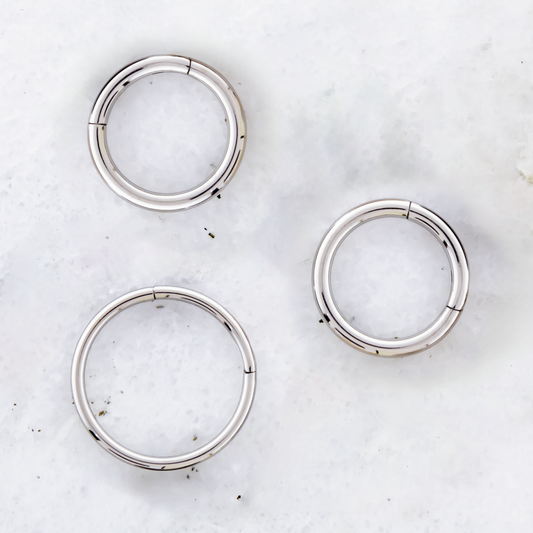
Mirror-polished steel hinged segment rings are the most widely purchased style in this collection and the most practical starting point for any healed placement. The high-polish surface requires minimal maintenance and works with any aesthetic from minimalist to layered. Plain steel clicker rings are available across the full gauge range from 20G through 10G, making them the most size-complete option in the collection. The clean look of a plain steel hinged segment ring suits septum, daith, and helix placements equally well.
Black PVD Hinged Rings
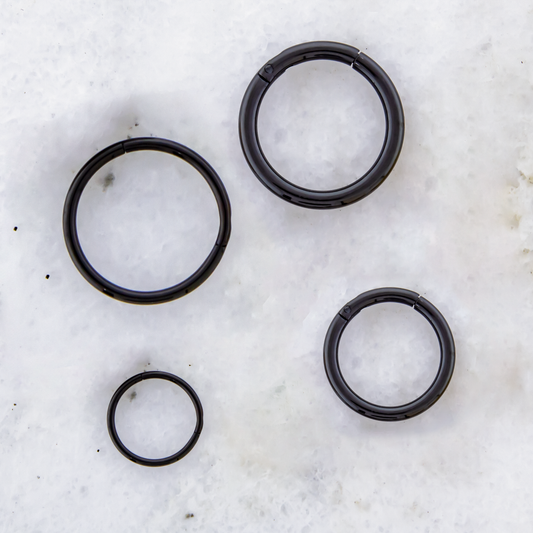
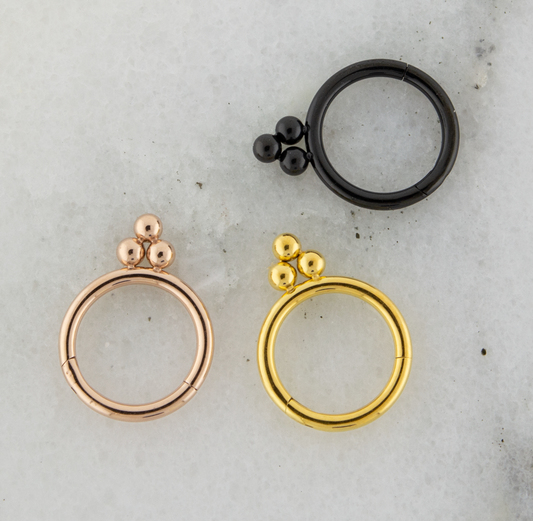
Physical vapor deposition coating bonds a black finish to the 316L steel surface at a molecular level, producing a result that is significantly more durable than standard plating. Black PVD steel hinged segment rings are among the most consistently popular options in this collection for wearers building a darker aesthetic across multiple ear placements or coordinating a septum ring with black jewelry in other locations. The black finish does not chip or peel under the mechanical stress of the hinge mechanism opening and closing repeatedly over time.
Gold and Colored PVD Clickers
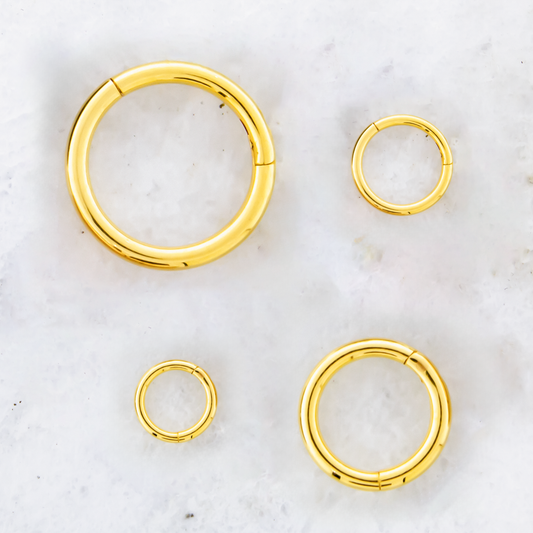
Gold PVD hinged segment rings follow the same deposition process as black PVD, applying a 24-karat gold tone to the 316L steel surface for a warm finish that holds significantly longer than traditional gold plating. Colored PVD options including rose gold and other tones extend the finish range for wearers who want to coordinate their hinged rings with other jewelry across different metals or styles. All colored PVD steel hinged segment rings maintain the 316L implant-grade steel core underneath the finish layer.
Decorative and Gem-Front Hinged Rings
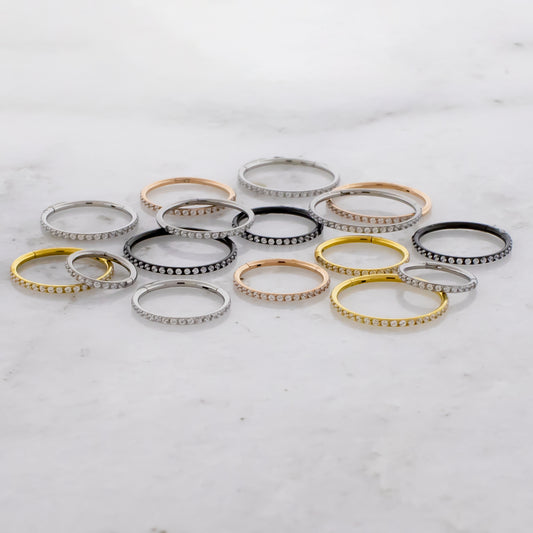
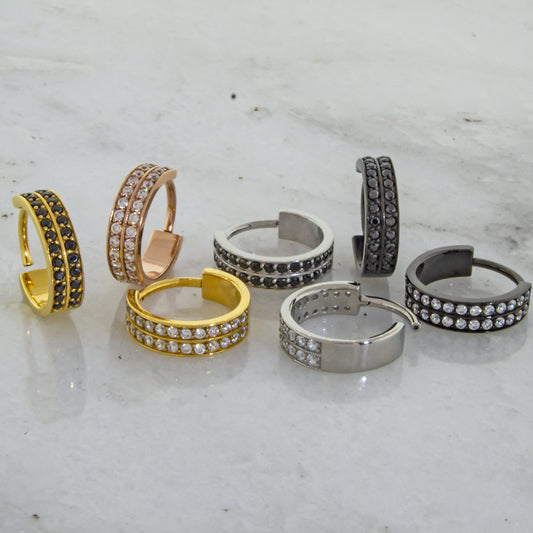
Some steel hinged segment rings in this collection feature a decorative front section with gem-set stones, engraved patterns, or shaped front panels. The front panel or gem replaces the plain steel segment on the visible portion of the ring while the rest of the hoop remains smooth steel. Decorative steel hinged segment rings are particularly popular for septum piercings where the front face is prominently displayed, and for daith piercings where the ring sits within the ear fold and benefits from a more visually detailed front piece.
See more: 316L Implant Grade Steel Rings
Gauge and Diameter Guide by Piercing
Gauge and diameter together determine whether a steel hinged segment ring fits correctly in a specific placement. Gauge must match your piercing exactly for the ring to pass through the channel. Diameter determines how the ring sits against the anatomy: too small creates pressure, too large causes the ring to hang away from the skin rather than following the body's contour.
Septum:
- Standard gauge: 16G or 14G; 12G, 10G, and 8G for stretched septum placements
- Common diameter: 8mm to 10mm for most adult anatomies
- Notes: An 8mm ring sits closer to the base of the nose; a 10mm ring hangs slightly lower
Daith:
- Standard gauge: 16G
- Common diameter: 8mm to 10mm; anatomy varies significantly here
- Notes: Confirm diameter from your existing jewelry before ordering
Helix and Cartilage:
- Standard gauge: 16G or 18G
- Common diameter: 8mm to 12mm depending on placement and ear anatomy
- Notes: Smaller diameter rings sit closer to the cartilage edge; larger rings allow more of the hoop to be visible
Conch:
- Standard gauge: 16G or 14G
- Common diameter: 10mm to 14mm
- Notes: The deeper position of the conch requires a larger diameter for the ring to wrap around the cartilage without pressure
Nose (Nostril):
- Standard gauge: 20G or 18G
- Common diameter: 6mm to 8mm
- Notes: Hinged segment rings at 20G in 6mm to 7mm are among the smallest and most discrete options in the collection
Lip and Labret:
- Standard gauge: 16G or 14G
- Common diameter: 8mm to 10mm
- Notes: Match diameter to the jewelry originally placed at piercing to avoid a ring that sits too tight or too loose
Measure the inner diameter of your current ring before ordering if you are replacing existing jewelry. Guessing diameter is the most common reason for a ring that does not look right in the placement.
How to Measure Your Current Ring
Remove your existing ring and measure the inner width from one inner edge to the directly opposite inner edge in a straight line. That measurement in millimeters is your inner diameter. For gauge, use a gauge wheel or ask your piercer if you are unsure. Standard gauge options in this collection are 20G, 18G, 16G, 14G, 12G, 10G, and 8G.
See more: 316L Steel Seamless Rings
Best Hinged Segment Ring Picks by Piercing
Different placements call for different combinations of gauge, diameter, and front style. Matching all three to the placement produces a ring that fits correctly and looks proportional.
For Septum Piercings
The septum is the highest-visibility placement for a steel hinged segment ring in this collection, and it is the placement where the decorative front panel makes the most visual impact. Plain steel clickers at 16G or 14G in 8mm to 10mm are the most commonly purchased septum sizes and cover the majority of adult anatomies. Decorative gem-front steel hinged segment rings are a popular upgrade for wearers who want the septum ring to be a statement piece rather than just a part of the overall look. For stretched septum placements at 12G, 10G, or 8G, the heavy gauge steel hinged segment ring options in this collection address that specific need that most general retailers do not stock.
For Daith and Cartilage Piercings
Daith piercings fit best with a 16G steel hinged segment ring at 8mm to 10mm inner diameter. The hinged clicker format is particularly practical for daith placements because the position inside the ear fold makes inserting a captive ring awkward. A hinged segment ring can be placed open against the daith entry point and clicked closed with one hand. Helix and conch placements follow similar sizing principles at 16G to 18G, with diameter selected based on how prominently the ring should sit against the ear. Plain steel and black PVD steel hinged segment rings are the most popular finishes for cartilage placements where the ring coordinates with other ear jewelry.
For Nose and Lip Piercings
Nostril piercings use the smallest steel hinged segment rings in this collection, typically 20G or 18G at 6mm to 8mm diameter. A hinged clicker at this size provides the same ease of daily removal and reinsertion as larger sizes, which makes it a practical upgrade from a standard screw-back or L-shaped nose stud for wearers who regularly remove their jewelry. Lip piercings that use a ring format work well with 16G steel hinged segment rings at 8mm to 10mm. The click closure is particularly useful for lip placements where getting a captive ball perfectly aligned while the ring is in a facial placement requires significant dexterity.
Why 316L Steel for Hinged Segment Rings?
A steel hinged segment ring worn in a septum or daith sits against internal nasal tissue or ear cartilage continuously. The hinge mechanism itself contacts the piercing tissue on one side as the ring rests in the channel. Material quality for a ring like this is not a cosmetic decision. It affects tissue response, surface integrity, and whether the latch mechanism maintains its precision over months and years of repeated use.
316L Implant-Grade Steel vs. Fashion Steel
Fashion-grade stainless steel hinged rings, widely available through general marketplace platforms, may look identical to implant-grade versions but are produced to a looser alloy standard. Higher nickel content in the base alloy migrates into surrounding tissue with prolonged contact, and less refined surface finishing creates micro-scratches on the ring surface that collect bacteria and body fluids over time. Implant-grade 316L stainless steel is formulated to a controlled chemical specification that minimizes nickel ion migration. The surface is non-porous and maintains its finish without tarnishing under normal daily wear. Every steel hinged segment ring in this collection is manufactured to that 316L specification, not merely labeled as surgical steel without verification.
PVD Coating: Durability on Clicker Rings
The hinged latch mechanism on a clicker ring experiences mechanical stress every time the ring is opened and closed. PVD coating on steel hinged segment rings must hold up to this repeated motion in a way that a standard electroplated finish cannot. Physical vapor deposition bonds the finish material to the 316L steel substrate at a molecular level rather than sitting on top of the surface. This gives PVD-coated steel hinged segment rings a durability advantage over plated alternatives, particularly at the hinge joint where surface stress concentrates during opening.
When to Consider Titanium Instead
If you have a confirmed nickel sensitivity, are purchasing a ring for a fresh or healing piercing, or have experienced persistent irritation from steel jewelry despite proper aftercare, ASTM F136 implant-grade titanium is the recommended material upgrade. Titanium contains no nickel by composition and is the most biocompatible metal available for body piercing jewelry. For fully healed piercings with no known metal sensitivities, 316L implant-grade steel performs reliably and costs less than titanium. The
ASTM F136 Titanium Rings collection offers the same hinged segment ring styles in nickel-free titanium for wearers who need that option.
Why Shop Steel Hinged Segment Rings at Pierced Addiction?
Pierced Addiction stocks steel hinged segment rings sourced to 316L implant-grade specification with hinge and latch mechanisms built to the tolerances that professional piercing studios require. The collection covers plain steel and PVD-finished clicker rings across a gauge range that extends from fine 20G nostril sizes through heavy 10G septum options.
Verified 316L implant-grade steel. Every steel hinged segment ring in this collection is manufactured to confirmed implant-grade 316L specification, not labeled as surgical steel without material verification.
Gauge range from 20G to 10G. The size coverage extends from fine nostril clickers through stretched septum gauges that are difficult to source at implant-grade standard outside specialist retailers.
Plain and decorative styles. Plain high-polish, PVD black, gold PVD, colored finishes, and gem-front decorative hinged rings are all available in one collection.
Free domestic shipping and same-day processing. Orders over $25 ship free via USPS economy. Domestic orders placed before 1pm are processed the same day.
Frequently Asked Questions
Find quick answers to the most common questions about steel hinged segment rings, ring mechanics, sizing, and material safety.
Are hinged segment rings and clicker rings the same thing?
Yes. Hinged segment ring and clicker ring are two names for the same jewelry. "Clicker" refers to the sound or feel of the latch closing. Both terms describe a ring with a built-in hinged latch that opens and closes without a separate ball or piece.
How do I open and close a hinged segment ring?
Locate the hinge on one side and the latch on the opposite side. Hold the ring steady and press the latch inward to disengage it, then swing the hinged segment open. Place the open ring in the piercing, align the segment, and press closed until the latch engages. A correctly closed ring will not flex or rattle.
What diameter should I get for a septum piercing?
Most adult septum piercings fit comfortably at 8mm to 10mm inner diameter. An 8mm ring sits closer to the nose tip; a 10mm ring hangs slightly lower. Measure your existing jewelry's inner diameter before ordering to confirm your size.
Is 316L steel safe for healed piercings?
Yes. 316L implant-grade steel is formulated to minimize nickel ion migration and is non-porous, making it appropriate for long-term daily wear in healed piercings. For fresh or healing piercings, ASTM F136 titanium is the preferred material.
How long does PVD coating last on steel hinged rings?
PVD coating on quality 316L steel hinged segment rings maintains its finish for years under normal daily wear and regular mild soap cleaning. PVD is significantly more durable than electroplating, including at the hinge joint where the ring surface flexes during opening and closing.
Steel hinged segment rings in 316L implant-grade steel give you the easiest ring change experience across the widest gauge range, in finishes from plain high-polish to decorative gem-front. Shop the full collection of steel hinged segment rings above to find your gauge, diameter, and style.