


Externally Threaded Barbells: Steel Straight Bars for Tongue, Nipple & Industrial Piercings
Externally threaded barbells in 316L implant-grade steel cover the full range of straight barbell placements, from tongue and nipple piercings to industrial and cartilage setups. This collection of externally threaded barbells spans 12G through 18G with multiple length options per gauge and finish choices from plain high-polish steel to black PVD. Every externally threaded barbell here is built to consistent thread tolerances for clean ball end changes on healed piercings.
What Is an Externally Threaded Barbell?
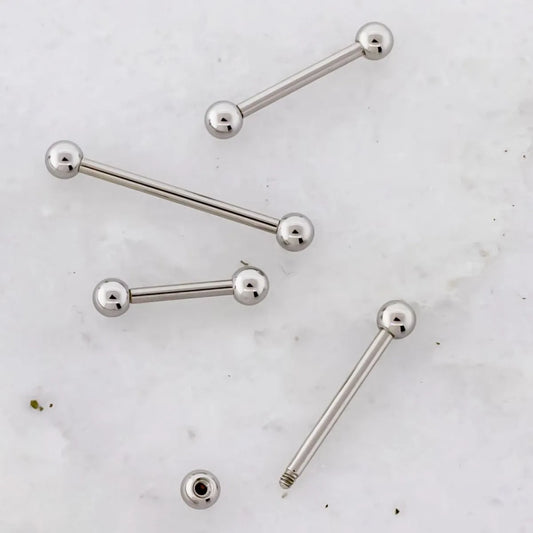
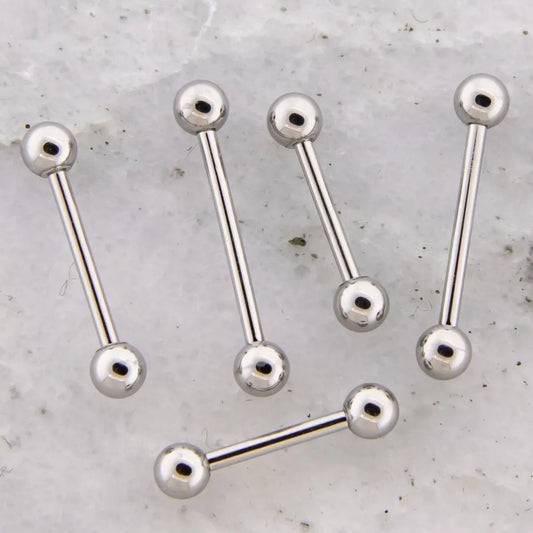
An externally threaded barbell is a straight steel post with a removable ball end on each side. The threading in this system is cut into the outside of the pin that extends from each ball end. Those threaded pins screw into the open tips at each end of the post, locking the balls in place. The post itself stays smooth throughout its length, and all of the thread hardware sits at the two tips where the ball ends engage.
Externally Threaded vs. Internally Threaded Barbells
The threading system determines how ball ends attach to the post and how much exposed hardware contacts the piercing channel during jewelry changes.
Externally Threaded:
- Thread ridges sit on the outside of the ball end pin
- Threaded surface contacts the post tip during attachment
- Appropriate for fully healed piercings where ends are changed infrequently
- More affordable manufacturing cost reflected in lower price point
- Compatible only with externally threaded ball ends of the same gauge
Internally Threaded:
- Threading is recessed inside the ball end, post tips stay smooth
- No exposed thread ridges contact tissue during jewelry changes
- APP-recommended for both initial and healed piercings
- Preferred by professional piercers for fresh and healing placements
- Compatible only with internally threaded ends
Externally threaded barbells are a practical, cost-effective choice for stable, fully healed piercings where jewelry is not being changed frequently. On a settled placement with no known sensitivities, the externally threaded system functions reliably without the additional cost of internally threaded jewelry.
Complete Barbell vs. Post Only
Some listings in this collection include the barbell post and ball ends together as a complete piece. Others offer the post alone, allowing you to pair it with externally threaded ends purchased separately. Post-only options suit wearers who already have ball ends they want to reuse, or who prefer to build a custom setup by mixing plain posts with gem or spike ends from the externally threaded ends range.
Externally Threaded Barbell Styles in This Collection
Every externally threaded barbell in this collection is machined from 316L implant-grade stainless steel. Variation across the lineup of externally threaded barbells comes from surface finish and end style, not from differences in base material quality.
Plain High-Polish Steel Barbells
Mirror-polished steel barbells are the most widely purchased option in this collection and the most practical replacement choice for any healed placement. The high-polish surface requires minimal maintenance, holds up to daily wear, and is compatible with any style of piercing from tongue to industrial. Plain steel externally threaded barbells are available across the full gauge and length range in this collection, making them the most size-complete option in the lineup.
Black PVD Coated Barbells
Physical vapor deposition coating bonds a black finish to the 316L steel surface at a molecular level, producing a result that is significantly more durable than standard plating. Black PVD externally threaded barbells maintain their finish under daily wear and regular cleaning in a way that electroplated alternatives cannot. This finish is consistently popular for oral piercings where a darker ball end reads clearly against the jewelry, and for nipple and industrial setups where the black tone coordinates with other jewelry in darker finishes.
Gem-End and Decorative Barbells
Some externally threaded barbells in this collection feature CZ gem-set ball ends or shaped decorative ends in place of standard plain balls. Gem-end barbells are most commonly chosen for oral piercings where the top ball is visible during speech, and for nipple piercings where a more polished finish is preferred over a plain steel ball. These styles are available primarily at 14G, covering the standard gauge for both placements.
See more: Steel Externally Threaded Ends
Sizing Guide by Piercing Type
Gauge and length are the two variables that determine whether an externally threaded barbell fits correctly. Getting gauge right ensures thread compatibility. Getting length right determines whether the barbell sits flush, allows for swelling, or creates excess post that snags and shifts. Both variables differ meaningfully between placements, and the correct sizing for a tongue piercing is not the same as for a nipple or industrial piercing.
Tongue Piercings (14G)
Tongue barbells use 14G as the near-universal standard gauge. Length is the variable that changes most between individuals and between stages of healing.
- Initial healing (weeks 1 to 6): 16mm to 19mm to accommodate tongue swelling
- Downsizing after swelling resolves (weeks 6 to 10): 12mm to 14mm for most anatomies
- Long-term healed wear: 12mm is the most common settled length; 10mm for shorter tongues
- Ball size: 4mm to 5mm on both ends; larger balls reduce the risk of accidentally swallowing the end
Wearing the initial long barbell beyond the swelling phase is one of the most common tongue piercing mistakes. A barbell that is too long for a healed tongue shifts against teeth and gum tissue with every movement. If your tongue barbell clacks against your teeth regularly, downsizing is overdue.
Nipple Piercings (14G)
Nipple piercings use 14G as the standard gauge, but barbell length varies more between individuals here than in any other common barbell placement. Nipple size and depth differ significantly, making measurement the only reliable approach.
- Standard length range: 12mm to 22mm depending on anatomy
- Most common healed length: 14mm to 16mm for average anatomy
- Initial piercing length: Typically 2mm to 4mm longer than the healed measurement to allow for swelling
- Ball size: 4mm to 6mm; larger balls distribute pressure more evenly across nipple tissue
If you are unsure of your length, the practical method is to remove your current barbell, measure from ball base to ball base excluding the balls themselves, and use that measurement as your post length reference.
Industrial Piercings (14G)
Industrial barbells are the longest straight barbell in standard piercing, spanning two cartilage points across the upper ear. Length is anatomy-specific and must be measured by a piercer or confirmed by measuring a correctly fitting existing piece.
- Most common lengths: 32mm, 35mm, and 38mm
- Standard gauge: 14G
- Ball size: 4mm to 5mm; smaller balls are less likely to catch on hair
- Critical note: Never order an industrial barbell shorter than your piercer's measurement. A barbell that is too short will apply constant pressure on both entry and exit points and will not sit straight
Industrial barbells sold in this collection are available in standard lengths. If your anatomy falls outside the common range, confirm your required length from a current fitting piece before ordering.
Cartilage Piercings (16G/18G)
Straight barbells used in cartilage placements such as anti-tragus are typically 16G. Standard cartilage barbells for non-industrial placements run significantly shorter than tongue or nipple versions.
- Standard gauge: 16G for most cartilage placements; 18G for finer anatomy
- Healed length: 8mm to 10mm for most placements
- Initial length: 10mm to 12mm to allow for cartilage swelling
- Ball size: 3mm to 4mm; smaller balls minimize visual bulk in the outer ear
All sizing above applies to healed piercings. For fresh piercings, confirm gauge and length with your piercer before purchasing any replacement jewelry.
How to Measure Your Current Barbell
Remove one ball end from your current barbell and measure the exposed post from tip to tip, excluding the threaded tips themselves. That straight measurement in millimeters is your post length. Round to the nearest standard available size (10mm, 12mm, 14mm, 16mm, 19mm, 32mm, 35mm, 38mm) and when in doubt between two options, choose the slightly longer one.
See more: Steel Externally Threaded Curved Barbells
Why Choose 316L Steel for Straight Barbells?
The material chosen for externally threaded barbells in each of these placements directly affects long-term comfort, tissue response, and the durability of the jewelry itself. A tongue barbell spends all of its time in direct contact with oral tissue and saliva. A nipple barbell sits against skin around the clock. An industrial barbell contacts cartilage tissue at two points simultaneously for months.
316L Implant-Grade Steel vs. Fashion Steel
Fashion-grade stainless steel body jewelry is common across general marketplace platforms and fashion retailers. It may carry the label "surgical steel" without meeting the chemical composition standards that implant-grade certification requires. The difference is not visible to the eye. For placements like tongue and nipple that involve extended daily contact with sensitive tissue, the nickel content and surface finish quality of the steel matters in a way that cosmetic similarity cannot resolve. Implant-grade 316L stainless steel is formulated to minimize nickel ion migration, is non-porous, and is corrosion-resistant under normal wear conditions. Every externally threaded barbell in this collection is produced to that specification.
PVD Coating: Durability on Steel Barbells
PVD coating bonds the finish to the 316L steel surface through a vacuum-based molecular process rather than depositing a film on top of the base material. The result is a finish that does not chip, peel, or flake under mechanical stress the way electroplated finishes do. On a tongue barbell that experiences constant movement and saliva exposure, or a nipple barbell cleaned daily, PVD coating on 316L steel maintains both its appearance and its surface integrity significantly longer than plated alternatives.
When to Consider Internally Threaded Instead
For fresh piercings, healing placements, or anyone who has experienced persistent irritation on an externally threaded setup, internally threaded barbells remove the externally threaded surface contact entirely. The
Steel Internally Threaded Barbells collection covers the same gauge range and placement types with a smooth post surface that is APP-recommended for all piercing stages.
Why Shop Externally Threaded Barbells at Pierced Addiction?
Pierced Addiction sources externally threaded barbells through Metal Mafia, a supplier with over two decades of experience supplying professional piercing studios across the United States. Every externally threaded barbell in this collection is machined from 316L implant-grade steel to consistent thread tolerances for reliable end changes without cross-threading.
Studio-sourced quality. Metal Mafia threading standards and surface finish specifications are built for professional studio supply requirements, not scaled to retail minimums.
Full gauge and length coverage. This collection covers the realistic replacement and downsizing needs of the most common straight barbell placements, from short 8mm cartilage bars through long 38mm industrial barbells.
Sold individually. Externally threaded barbells in this collection are sold individually, allowing you to buy one replacement post or stock multiple lengths across different placements in a single order.
Free domestic shipping and same-day processing. Orders over $25 ship free via USPS economy. Domestic orders placed before 1pm are processed the same day.
Frequently Asked Questions
Find quick answers to the most common questions about externally threaded barbells, sizing by placement, and material safety.
What length barbell do I need for a tongue piercing?
For initial healing, 16mm to 19mm is standard to accommodate swelling. Once swelling resolves at 6 to 10 weeks, most people downsize to 12mm to 14mm. Confirm your healed length by measuring your current post before ordering a replacement.
Are externally threaded barbells safe for healed piercings?
Yes. Externally threaded barbells in 316L implant-grade steel are appropriate for fully healed piercings. The externally threaded system is not recommended for fresh or healing piercings where the post moves through tissue repeatedly.
Can I swap the ball ends on externally threaded barbells?
Yes. Ball ends unscrew counterclockwise. Replacement ends must be externally threaded and match the gauge of the barbell exactly. A 14G end will not thread correctly onto a 16G post.
What gauge is standard for nipple vs. tongue piercings?
Both nipple and tongue piercings use 14G as the standard gauge. The key difference is barbell length: tongue piercings typically use 12mm to 16mm healed, while nipple piercings range from 12mm to 22mm depending on anatomy.
How do I measure my current barbell length?
Remove one ball end and measure the exposed post from tip to tip, excluding the threaded tips. That measurement in millimeters is your post length. Use the nearest standard size available in this collection.
Externally threaded barbells in 316L implant-grade steel cover the full range of straight barbell placements at a cost-effective price point. Shop the complete selection of externally threaded barbells above to find your gauge, length, and finish for tongue, nipple, industrial, or cartilage piercings.