
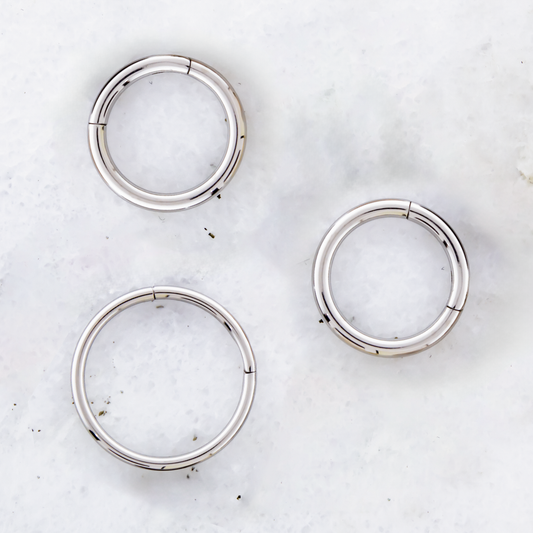
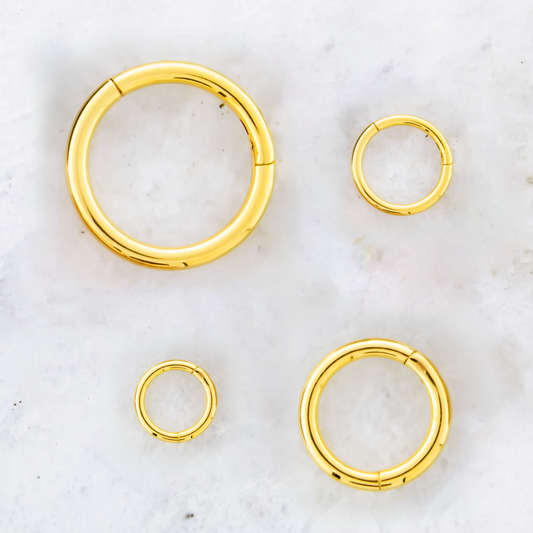






Solid Gold Threadless Labret Posts: 14K & 18K Press-Fit Posts for Every Placement
Solid gold threadless labret posts from Khrysos complete the foundation of any gold piercing setup. This threadless labret post collection covers 14K and 18K solid gold flat-back posts in yellow, white, and rose gold across gauges 20G through 16G and lengths from 6mm to 10mm, compatible with all standard threadless ends for lobe, nostril, cartilage, and facial piercings.
What Is a Threadless Labret Post?
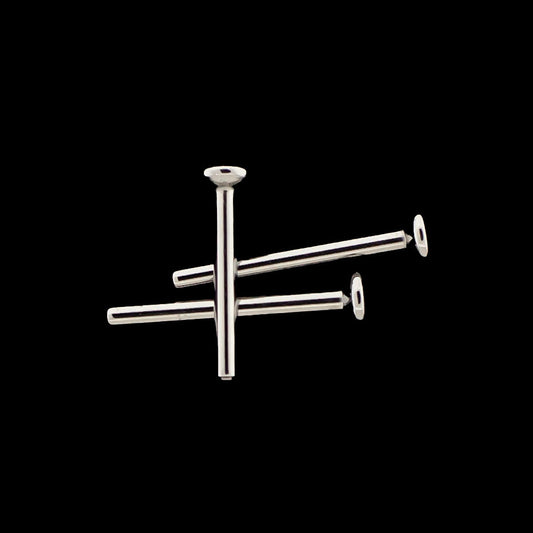
A threadless labret post, also called a labret threadless post, is a flat-back post that uses a press-fit pin system rather than threads to hold the decorative end in place. The post itself has a hollow opening at the top. The decorative end has a small bent metal pin on its back. When that pin is inserted into the post's hollow opening, the spring tension of the bent pin locks the end in place securely enough for daily wear, handling, and cleaning. To release the end, you hold the post steady from the back and pull the end forward with a firm, direct motion.
The flat-back design means the disc on the back of the post sits flush against the skin behind the piercing rather than extending a sharp post tip through the tissue. This flat profile is the reason threadless labret posts are recommended by professional piercers for placements where comfort during sleep and extended wear matters.
How the Threadless Push-Fit System Works
The threadless system separates the post from the end entirely, which makes swapping decorative ends a practical, tool-free process. The post stays in the piercing while you change the end. Insert a new end's pin into the hollow opening, press until the tension clicks into hold, and the change is complete. No ring-opening pliers, no unscrewing in tight spaces, no replacing the entire piece of jewelry.
For buyers building a gold setup across multiple placements, a threadless labret post at the correct gauge and length can anchor multiple different decorative ends over the lifespan of the post.
Why Solid Gold Posts Matter for a Complete Gold Setup
A gold decorative end on a titanium post looks cohesive from the front of the piercing. The gap becomes visible from the back — in lobe piercings viewed at close range, in nostril piercings photographed from certain angles, and in any placement where someone has reason to look at the back of the jewelry. A solid gold threadless labret post completes the material consistency of the setup at both the visible end and the structural post.
For wearers building a curated ear look or a deliberately premium piercing setup, the post is not an afterthought. It is the part of the jewelry that stays in the piercing continuously, making material quality at the post level as important as the quality of the end.
Why the Pin Is Titanium Even on a Gold Post
Every solid gold threadless labret post in this collection uses an ASTM F136 implant-grade titanium pin rather than a gold pin. This is not a cost-cutting decision — it is a material engineering one. Gold at 14K or 18K is softer than titanium. A gold pin would not maintain the spring tension required to hold the decorative end reliably over repeated insertion and removal cycles. The titanium pin provides the elasticity and resilience that makes the press-fit mechanism work correctly long-term. The gold is the post body, disc, and decorative elements; the titanium pin is the structural mechanism that holds everything together.
Solid Gold vs. Gold-Plated vs. Gold-Filled Posts
The body jewelry market includes posts described as gold that use very different constructions. Understanding the distinction is the most important step before purchasing a threadless labret post for a healed piercing.
Solid 14K and 18K Gold Posts
A solid gold threadless labret post has gold content present throughout the entire piece at the stated karat percentage. A 14K solid gold post is 58.3% gold by weight, from the surface of the flat back disc through the core of the post shaft to the top opening. There is no base metal beneath the gold that the piercing tissue will eventually contact as the surface wears. The gold tone will not change, fade, or flake under normal daily wear, cleaning product exposure, or the mechanical contact involved in changing threadless ends.
From a biocompatibility standpoint, solid 14K yellow and rose gold is nickel-free and recognized by the APP as appropriate for long-term piercing post use in healed placements. Solid 18K gold has the same properties at a higher gold content.
What Gold-Plated and Gold-Filled Mean
Gold-plated posts use a thin gold layer applied through electroplating over a base metal. The layer thickness is measured in microns. Under daily wear, this layer wears through at contact points — most commonly at the back disc where it contacts skin, and at the post shaft where it passes through the piercing channel. Once the plating wears through, the base metal underneath contacts the tissue. Base metals in plated jewelry vary and often contain nickel.
Gold-filled posts use a thicker gold layer than plating — typically 5% gold by weight bonded under heat and pressure to a base metal core. The layer is more durable than plating but is still not solid gold. For a post worn continuously in a piercing over years, the distinction between filled and solid remains significant.
Every threadless labret post in this collection is solid 14K or 18K gold throughout. No plating, no fill layer, no base metal beneath the gold surface.
14K vs. 18K Gold Threadless Labret Posts
Both karat levels are available across the threadless labret post lineup in this collection. The choice between them involves durability, color tone, and price rather than safety — both are appropriate for healed piercings.
14K Gold Posts
At 58.3% gold content, 14K gold is harder and more durable than 18K. For a threadless labret post that is inserted and removed less frequently than the ends it holds, the additional hardness of 14K provides a post shaft that maintains its shape under the mechanical stress of daily wear in a piercing channel over an extended period. 14K yellow gold has a warm, recognizable gold tone that reads clearly as gold without the deeper saturation of 18K. 14K white gold and rose gold are also available in this collection and use the same karat-level hardness advantage. The 14K tier represents the most widely purchased post format in this collection.
18K Gold Posts
At 75% gold content, 18K gold is softer than 14K and has a distinctly richer, deeper gold tone in yellow. For buyers whose priority is the most luxurious gold color rather than maximum durability, 18K posts deliver that visual warmth. In placements where the post is not changed frequently and sits undisturbed in a healed piercing, the softness difference between 14K and 18K is not a practical concern. The 18K tier is the premium choice for buyers building the highest-quality threadless labret post setup or matching to existing 18K jewelry.
See more: 14K Gold Threadless Ends
How to Choose the Right Post Length and Gauge
Post length and gauge are the two critical sizing decisions for any threadless labret post or labret threadless post purchase. A wrong gauge means the post will not fit the piercing. A wrong length means the post either creates pressure against healing tissue or leaves excess shaft visible at the entry point.
Gauge Selection
- 20G (0.8mm): The finest gauge available in this collection. Used for delicate nostril piercings and standard lobe piercings in buyers who prefer a minimal profile.
- 18G (1.0mm): The most commonly purchased gauge in this collection, covering standard lobe piercings, nostril piercings, helix, tragus, and most lip and labret placements.
- 16G (1.2mm): Used for conch piercings, cartilage placements with thicker tissue, and for wearers whose original piercing was done at 16G.
If you are replacing an existing post and are uncertain of your gauge, measure the shaft of your current post with a digital caliper or gauge wheel, or ask your piercer. Never estimate gauge from appearance — 18G and 20G look visually similar and are not interchangeable.
Length Selection by Placement
- 6mm (1/4 inch): Standard length for a healed standard lobe piercing and a healed nostril piercing in most anatomies. The post shaft fills the piercing channel with minimal excess.
- 8mm (5/16 inch): Standard length for healed cartilage piercings including helix, tragus, and conch. Also used for lobe piercings with thicker tissue or for initial healing where some clearance for swelling is needed.
- 10mm (3/8 inch): Used for deeper tissue placements, for initial piercing setups where swelling is anticipated, or for lip and labret placements where the distance from entry to exit is greater.
How to Measure Your Current Post
Remove the decorative end from your existing post by holding the flat back disc and pulling the end forward. Then hold the post and measure the shaft from the flat surface of the disc to the tip of the opening at the top. That millimeter measurement is your current post length. Order a replacement at the same measurement, or one size up if the current post feels tight against the tissue.
Flat Back Disc Size
The flat back disc is the small circular plate on the back of the post that prevents the jewelry from pulling forward through the piercing. Disc sizes in this collection are 2.5mm and 3mm. A 2.5mm disc creates a finer, more delicate profile at the back of the piercing. A 3mm disc is the standard and provides slightly more surface area against the skin. Both sizes hold the post equally securely — the choice is a visual and comfort preference rather than a functional one.
See more: Titanium Threadless Ends
Placements for Solid Gold Threadless Labret Posts
A single solid gold threadless labret post at the correct gauge and length works across every piercing that uses a flat-back post format. The placement determines which gauge and length to select for the solid gold threadless labret post; the format itself is universal.
Ear Placements
Lobe piercings are the most common placement for solid gold threadless labret posts. A 20G or 18G post at 6mm fits most healed standard lobe piercings and pairs with any 14K gold threadless end to create a complete gold lobe setup. Upper lobe piercings follow the same sizing. Helix and tragus piercings typically use an 18G post at 8mm, where the post passes through the cartilage and the flat disc sits against the back of the ear. Conch piercings use 16G or 18G at 8mm to 10mm depending on the depth of the piercing placement.
Facial Placements
Nostril piercings are among the most visible placements for a solid gold threadless labret post because both the decorative end and the back disc are visible from different angles. A 20G or 18G post at 6mm fits most healed nostril piercings. The flat back disc on the inside of the nostril is less visible than the standard ball-back of a nose stud, making the threadless labret format a cleaner option for nostril jewelry overall. Labret piercings below the lip, medusa and philtrum piercings above the upper lip, and Monroe piercings all use 16G or 18G posts at 8mm to 10mm depending on the lip and tissue depth.
Building a Complete Gold Threadless Setup
The most effective approach to a complete gold threadless setup is to select the threadless labret post first — confirmed gauge, confirmed length, confirmed gold tone — then build the decorative end collection from that foundation. A single threadless labret post at a given placement can hold dozens of different gold ends over its lifespan. The threadless labret post is the investment piece; the ends are the styling layer.
See more: Solid Gold Threadless Ends
Why Choose Khrysos Gold Threadless Posts at Pierced Addiction?
Khrysos is the dedicated solid gold jewelry brand developed in-house at Pierced Addiction specifically for body piercing applications. Every threadless labret post in this collection is produced under the Khrysos specification rather than adapted from fashion jewelry formats.
ISO9001-certified manufacturing. Khrysos posts are produced in facilities certified to the ISO9001 quality management standard, which governs material traceability, dimensional consistency, and surface finish quality across production runs.
Solid 14K and 18K gold confirmed throughout. The gold content at both karat levels is present from the post surface to the core. No plating layer, no gold fill over base metal.
Nickel-free alloy in yellow and rose gold. Khrysos yellow and rose gold posts use nickel-free gold alloys appropriate for direct, long-term contact with piercing tissue. White gold alloy composition is specified per product listing.
ASTM F136 titanium pin. The press-fit pin on every Khrysos solid gold threadless labret post is made from implant-grade titanium to maintain the spring tension and corrosion resistance the threadless mechanism requires.
Universal threadless compatibility. Khrysos solid gold threadless labret posts and labret threadless posts are compatible with all standard threadless ends at matching gauge, including ends from other brands.
Free domestic shipping and same-day processing. Orders over $25 ship free via USPS economy. Domestic orders placed before 1pm are processed the same day.
Frequently Asked Questions
Find quick answers to the most common questions about solid gold threadless labret posts, sizing, compatibility, and karat selection.
Are solid gold threadless labret posts and labret threadless posts compatible with all threadless ends?
Yes. Khrysos solid gold threadless labret posts use a standard threadless hollow opening that accepts any threadless end at the matching gauge, regardless of brand. They are not compatible with internally threaded or externally threaded ends.
What length post do I need for a nostril piercing?
Most healed nostril piercings fit a 6mm post at 20G or 18G. If your current jewelry feels tight against the inside of the nostril, 8mm provides additional clearance. Measure your existing post before ordering if you are unsure.
Why does my gold post have a titanium pin?
The bent pin that holds the decorative end in place needs to maintain spring tension under repeated use. Gold at 14K or 18K is not hard enough to sustain that tension reliably over time. ASTM F136 titanium has the elasticity and resilience to hold the press-fit mechanism correctly without the pin losing its tension or shape.
What is the difference between 14K and 18K gold posts?
14K gold is 58.3% gold and harder than 18K. It is more durable for post use in high-wear placements and has a warm gold tone. 18K gold is 75% gold, softer, and has a richer, deeper gold color. Both are nickel-free in yellow and rose gold and appropriate for healed piercings.
Can I use a solid gold threadless labret post in a fresh piercing?
Solid 14K or 18K gold is body-safe for fresh piercings when the alloy is nickel-free. Initial post length for a fresh piercing should allow for swelling — typically 8mm to 10mm rather than the standard healed length of 6mm. Confirm the length with your piercer before purchasing for a new piercing.
A solid gold threadless labret post from Khrysos is the foundation that makes the rest of a gold piercing setup work. Shop the full threadless labret post collection above to find your karat, gauge, length, and gold tone.