
316L Steel Seamless Rings: Annealed Hoops for Nose, Ear & Body Piercings
316L steel seamless rings deliver the cleanest ring aesthetic in body piercing: a continuous hoop with no visible ball, no latch, and no hardware interrupting the circle. These rings are annealed, meaning the steel is heat-treated to make twisting the ring open and closed easier without permanently deforming it. This collection spans 20G through 14G in plain polish, PVD-coated, and shaped styles for nose, septum, daith, helix, and cartilage placements.
What Is a Steel Seamless Ring?
A steel seamless ring is a complete circle of implant-grade steel with a single precision cut through the band. There are no balls, no latches, and no separate pieces. To open the ring, you hold each side of the cut and twist the two ends in opposite directions until there is a gap large enough to guide the ring through the piercing. To close it, you twist the ends back until they realign and the seam disappears. The result is a ring that looks like an unbroken hoop from any angle.
Seamless Ring vs. Hinged Segment Ring: Which Is Which?
The term "hinged seamless ring" appears frequently in body jewelry searches and creates genuine confusion. These are two distinct ring types with different opening mechanisms and different visual results.
A steel seamless ring has no moving parts. The ring itself is the only piece, and it opens by twisting. The seam is invisible when the ring is properly closed and aligned. A hinged segment ring, by contrast, has a built-in hinged latch that clicks open and closed. When closed, it also looks like a continuous hoop, but there is a small gap or latch point visible on close inspection.
If you want the absolute minimum visible hardware and are comfortable with a twist-open mechanism, the steel seamless ring is the correct choice. If you want easier single-handed changes with a click-close latch, browse the
316L Steel Hinged Segment Rings collection instead.
What "Annealed" Means for Seamless Rings
Annealing is a heat treatment process that alters the internal structure of the steel at a metallurgical level. When steel is annealed, it becomes softer and more ductile than standard hardened steel. For a seamless ring, this means the ring can be twisted open and closed repeatedly without developing stress fractures at the seam or permanently deforming into an oval shape.
Non-annealed seamless rings made from fully hardened steel require significant force to open and close. That force either distorts the ring permanently after several changes or makes routine jewelry changes frustrating enough that wearers avoid changing their jewelry at all. Every steel seamless ring in this collection is annealed by Metal Mafia to the specification that professional piercing studios require for daily-wear ring jewelry.
How to Open and Close a Steel Seamless Ring
The technique matters more than the force for a seamless ring. Hold the ring with the seam positioned between both hands, with one hand on each side of the cut. Apply a twisting motion in opposite directions, rotating one side toward you and the other away from you. Do not pull the ends apart like opening a link; this oval-distorts the ring. Once the gap is wide enough to clear the piercing channel width at your gauge, place the ring against the piercing and guide it through. To close, reverse the twist until the seam edges meet flush and no gap is visible.
Steel Seamless Ring Styles in This Collection
Every steel seamless ring in this collection is annealed 316L implant-grade stainless steel. The full circle construction makes surface finish and profile the primary differentiating factors across the lineup.
Plain High-Polish Steel Seamless Rings
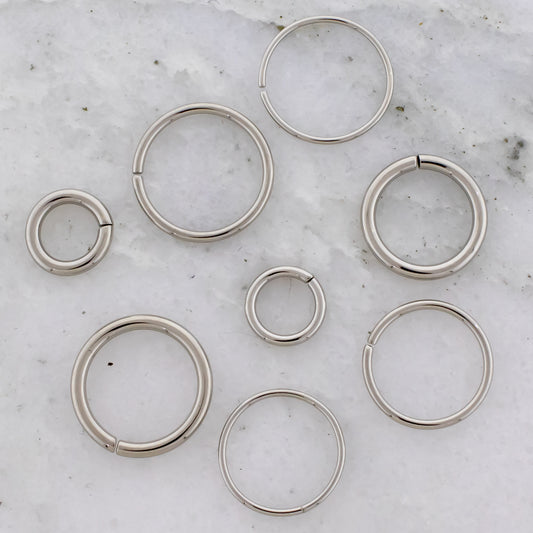
The mirror-polished steel seamless ring is the most widely purchased style in this collection. The high-polish finish reflects light evenly around the full hoop and makes the seam as invisible as possible when the ring is correctly aligned. Plain steel seamless rings are available across the widest gauge and diameter range in this collection, from 20G nose rings through 14G septum hoops, making them the most size-complete option for wearers who need a specific gauge or diameter not available in decorative styles.
PVD-Coated Seamless Rings
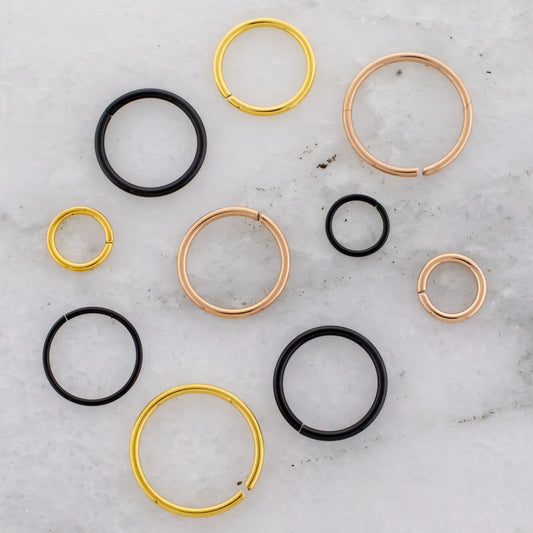
Physical vapor deposition coating is applied to the 316L steel surface before the ring is annealed-shaped, bonding the finish at a molecular level rather than sitting on top of the steel. This process produces a significantly more durable result than standard electroplating, even at the seam where the ring flexes during twisting. PVD steel seamless rings are available in black, gold, and rose gold in this collection. Black PVD seamless rings are particularly popular for daith, helix, and nostril placements where a darker tone coordinates cleanly with other ear jewelry without drawing attention to any specific piece.
Shaped and Decorative Seamless Rings
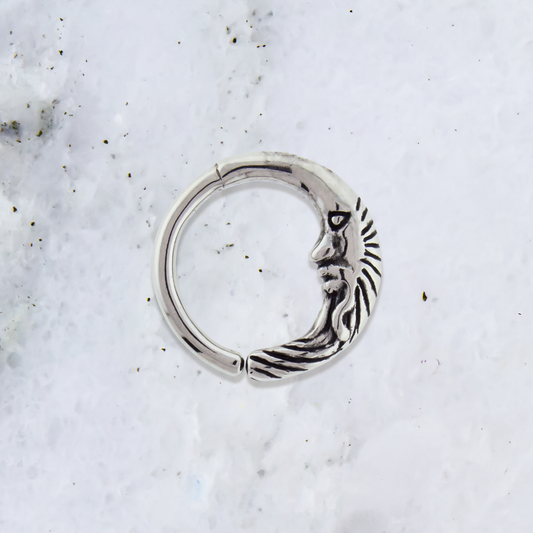
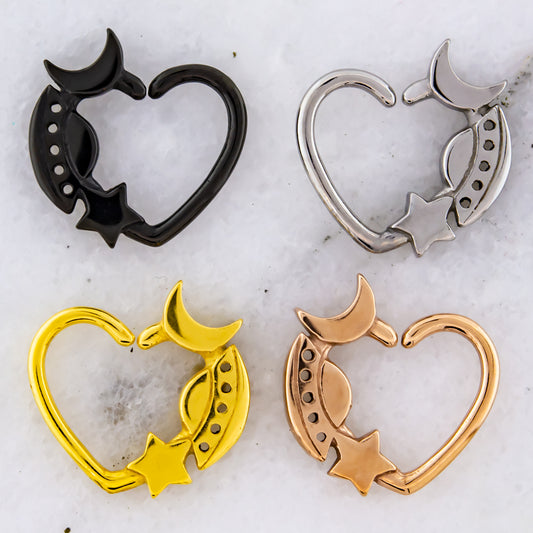
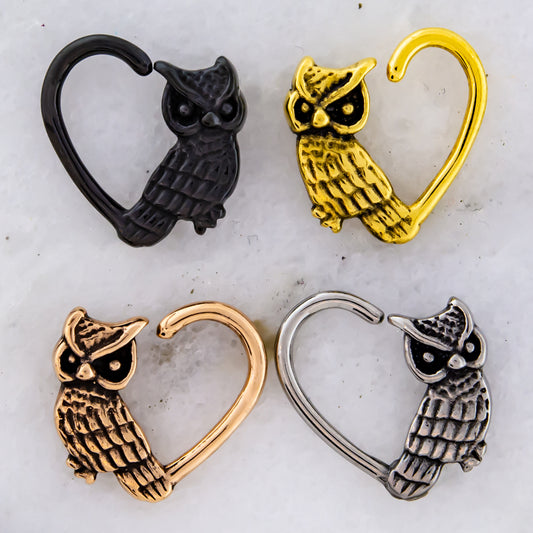
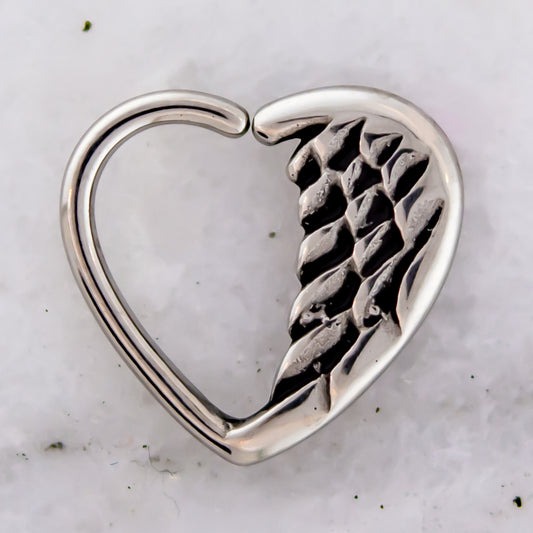
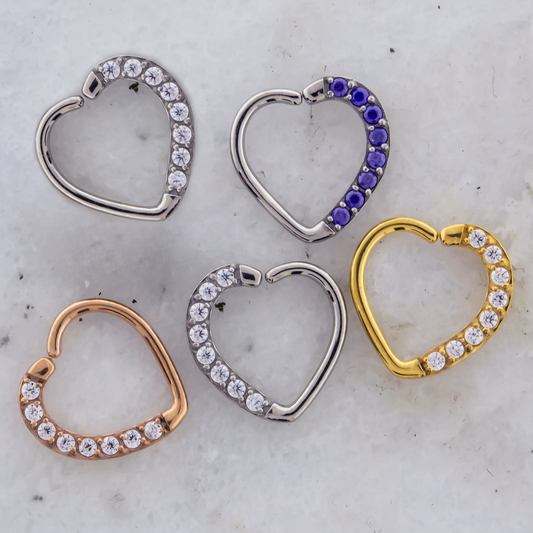
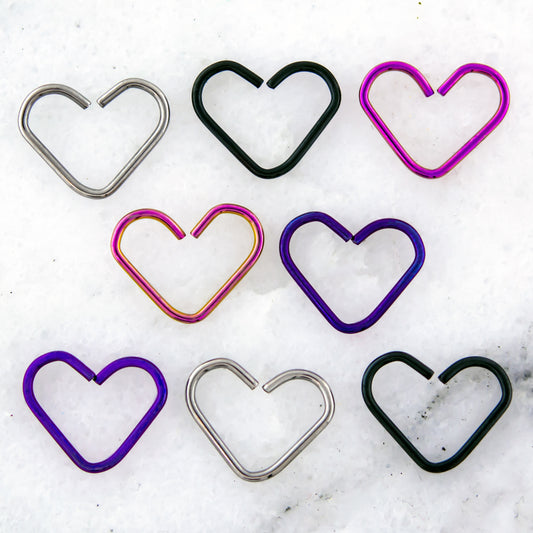
Some steel seamless rings in this collection replace the plain band with a shaped front section, such as a heart, star, moon, or leaf cutout, while the rest of the hoop remains smooth round wire. The shaped section sits on the visible front of the ring while the seam stays tucked against the back of the placement. Shaped seamless rings work best in placements where the front of the ring is clearly visible and centered, such as the nose, daith, and helix, where the decorative shape reads against the skin rather than disappearing into the ear fold.
Colored Anodized Seamless Rings
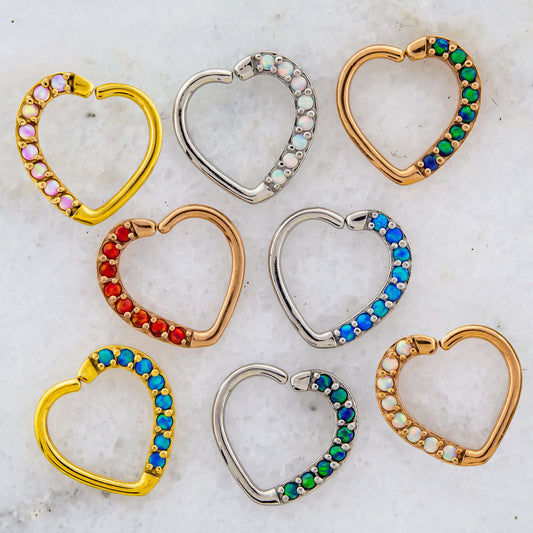
Colored anodized steel seamless rings use an electrochemical process to create vibrant surface colors including blue, purple, teal, and rainbow across the 316L steel band. Anodized finishes on steel are not as durable as PVD but produce more vivid and varied color options than PVD coating allows. These rings are best suited to placements that see limited physical contact and jewelry changes, such as the helix and daith, where the color remains visible and the ring is not twisted open and closed frequently.
See more: 316L Steel Hinged Segment Rings
Gauge and Diameter Guide by Piercing
Getting the gauge and diameter right is more critical with seamless rings than with captive or hinged rings because there is no ball-size adjustment and no latch tension to compensate for a slightly wrong diameter. The ring must pass through the piercing channel at the correct gauge, and the diameter must suit the anatomy of the specific placement.
Nose (Nostril):
- Recommended gauge: 20G or 18G
- Common diameter: 6mm to 8mm
- Notes: A 6mm seamless ring sits flush against the nostril; 8mm wraps more visibly around the nostril edge
Septum:
- Recommended gauge: 16G or 14G
- Common diameter: 8mm to 10mm
- Notes: Confirm anatomy with a mirror before ordering; 8mm sits closer to the nose base, 10mm hangs lower
Helix and Cartilage:
- Recommended gauge: 16G or 18G
- Common diameter: 8mm to 12mm
- Notes: Forward helix placements typically need 6mm to 8mm; outer helix and conch use larger diameters
Daith:
- Recommended gauge: 16G
- Common diameter: 8mm to 10mm
- Notes: Daith anatomy varies significantly; measure your existing ring or confirm with your piercer before ordering
Rook:
- Recommended gauge: 16G
- Common diameter: 8mm to 10mm
- Notes: A ring that is too small for the rook will press against the cartilage fold; confirm diameter from existing jewelry
Lip and Labret:
- Recommended gauge: 16G or 14G
- Common diameter: 8mm to 10mm
- Notes: Match gauge and diameter to the jewelry originally placed at piercing
When replacing a seamless ring, measure your current ring's inner diameter before ordering. Seamless rings do not have ball-size adjustability, so the diameter must be accurate. When uncertain between two sizes, choose the slightly larger option to avoid a ring that sits too tight against the tissue.
How to Measure Your Current Ring
Remove your existing ring and measure the inner width from one inner edge to the directly opposite inner edge in a straight line. That millimeter measurement is your inner diameter. For gauge, use a gauge wheel or ask your piercer. Standard gauge options in this collection are 20G, 18G, 16G, and 14G.
See more: 316L Implant Grade Steel Rings
Best Seamless Ring Picks by Piercing
Different placements call for different sizing and style decisions. Matching gauge, diameter, and surface finish to the placement produces a seamless ring that looks right and sits comfortably.
Nose and Nostril Piercings
The nostril is the most popular placement for a 316L steel seamless ring because the ring's continuous look suits the clean, delicate aesthetic that most nostril piercings aim for. A 20G or 18G plain steel seamless ring at 6mm to 7mm is the most commonly purchased size for standard nostril anatomy. Shaped steel seamless rings with a heart or star front work particularly well on the nostril because the front of the ring is clearly visible and the shape reads against the skin. PVD black and gold seamless rings at 20G and 18G are also widely used for nostril placements where a metallic tone finish coordinates with other facial jewelry.
Septum Piercings
A steel seamless ring at 16G to 14G in 8mm to 10mm creates the minimal, continuous look that many septum wearers prefer over a horseshoe or clicker style. The seam on a properly fitted and aligned seamless ring is invisible from the front, making it the most visually understated septum jewelry option in this collection. Plain high-polish steel seamless rings are the most popular septum choice here, though PVD gold and black options are consistently purchased by wearers building a coordinated metal finish across their piercings. Septum seamless rings can be flipped up inside the nose when needed; confirm the diameter fits inside your nose comfortably before selecting the smaller 8mm option.
Daith, Helix, and Cartilage Piercings
Daith, helix, rook, and conch piercings all use steel seamless rings at 16G to 18G in 8mm to 12mm depending on the placement depth and ear anatomy. The annealed construction of these steel seamless rings makes them easier to open for daith and helix changes compared to non-annealed alternatives. The daith is a particularly common placement for steel seamless rings because the ring sits within the innermost cartilage fold where a continuous hoop is visible from the front without any latch hardware drawing attention. Helix and conch placements accommodate a wider diameter range, with conch piercings often using 10mm to 14mm to allow the ring to wrap comfortably around the deeper cartilage position.
Why 316L Implant-Grade Steel for Seamless Rings?
Seamless rings undergo more regular mechanical stress than most other ring types because they are opened by twisting rather than unlatching. The material must withstand repeated twisting without surface cracking, seam degradation, or nickel migration into the piercing tissue over months of daily wear.
316L Steel vs. Fashion Steel for Seamless Rings
The gap between implant-grade and fashion-grade steel is particularly relevant for seamless rings. A fashion-grade seamless ring may look identical to a 316L implant-grade version but is produced from a looser alloy standard with higher nickel content and less refined surface finishing. Over repeated twisting cycles, micro-cracks can develop at the seam of a lower-quality ring, creating rough edges that irritate the piercing channel. Implant-grade 316L stainless steel has a controlled chemical composition that minimizes nickel ion migration and maintains surface integrity under repeated mechanical stress. Every 316L steel seamless ring in this collection is produced to that specification by Metal Mafia, not simply labeled "surgical steel" without material verification.
Why Annealing Matters Specifically for Seamless Rings
The annealing process applied to Metal Mafia steel seamless rings is not standard practice across all body jewelry manufacturers. Many seamless rings on the general market are cut from hardened steel tubing without any post-process heat treatment. Hardened steel seamless rings require much more force to open and develop oval distortion faster than annealed rings under repeated use. The annealed construction in this collection means the ring opens with a reasonable twist force, returns to a round profile when closed, and maintains that behavior across hundreds of open-and-close cycles over its lifespan.
PVD Coating Durability on Twist-Open Rings
PVD-coated steel seamless rings experience surface stress at the seam during each twist cycle. The molecular-level bonding of PVD coating holds up to this flexing better than electroplated finishes, which sit on top of the steel surface and can crack or flake at the seam over time. For wearers who change their seamless rings regularly, a PVD steel seamless ring maintains its color and surface integrity through repeated use in a way that a plated alternative cannot.
When to Consider Titanium Instead
If you have a confirmed nickel sensitivity or are purchasing a seamless ring for a fresh or healing piercing, ASTM F136 implant-grade titanium is the recommended material. Titanium contains no nickel by composition, is lighter than steel, and is the most biocompatible metal for body jewelry. For fully healed piercings with no known sensitivities, 316L implant-grade annealed steel performs reliably at a lower cost. The
ASTM F136 Titanium Rings collection covers seamless and hinged ring styles in nickel-free titanium for wearers who need that option.
Why Shop 316L Steel Seamless Rings at Pierced Addiction?
Pierced Addiction carries 316L steel seamless rings from Metal Mafia, a supplier that has supplied professional piercing studios across the United States for over two decades. The annealed construction is specified to professional studio standards, not the general retail minimum.
Annealed 316L implant-grade steel from Metal Mafia. Every steel seamless ring in this collection is heat-treated to allow easy, non-distorting open-and-close cycles, and manufactured to confirmed 316L implant-grade specification.
Gauge range from 20G to 14G. The size coverage spans fine 20G nostril rings through 14G septum hoops, covering the realistic needs of the most common seamless ring placements.
Plain, PVD, shaped, and colored styles. High-polish steel, PVD black and gold, shaped decorative fronts, and colored anodized options are all available in one collection.
Free domestic shipping and same-day processing. Orders over $25 ship free via USPS economy. Domestic orders placed before 1pm are processed the same day.
Frequently Asked Questions
Find quick answers to the most common questions about 316L steel seamless rings, ring mechanics, annealing, and sizing.
What is the difference between a seamless ring and a hinged segment ring?
A seamless ring twists open and closed with no separate parts. A hinged segment ring has a built-in latch that clicks open and shut. Both look like continuous hoops when closed, but the opening mechanism is completely different.
What does "annealed" mean for a seamless ring?
Annealing is a heat treatment that softens the steel, making the ring easier to twist open and closed without permanently distorting its shape. Non-annealed seamless rings require more force and deform into an oval faster over repeated use.
How do I open a steel seamless ring without distorting it?
Hold the ring with one hand on each side of the seam. Twist the two sides in opposite directions, rotating one toward you and one away from you. Do not pull the ends apart sideways. Pulling instead of twisting distorts the ring into an oval shape.
What diameter seamless ring fits a standard nostril piercing?
Most standard nostril piercings fit a 6mm to 8mm inner diameter at 20G or 18G. A 6mm ring sits flush against the nostril; 8mm wraps more visibly around the nostril edge. Measure your existing jewelry if unsure.
Can I use a seamless ring in a fresh piercing?
Seamless rings are appropriate for fully healed piercings. For fresh or healing piercings, your piercer will typically recommend a flat back labret or a piece that does not need to be twisted through the healing channel. Confirm with your piercer before changing jewelry on a healing placement.
Annealed 316L steel seamless rings give your piercings the cleanest continuous hoop look available in this collection, with a twist-open mechanism that is easier to manage than a non-treated alternative. Shop the full selection of steel seamless rings above to find your gauge, diameter, and finish.