
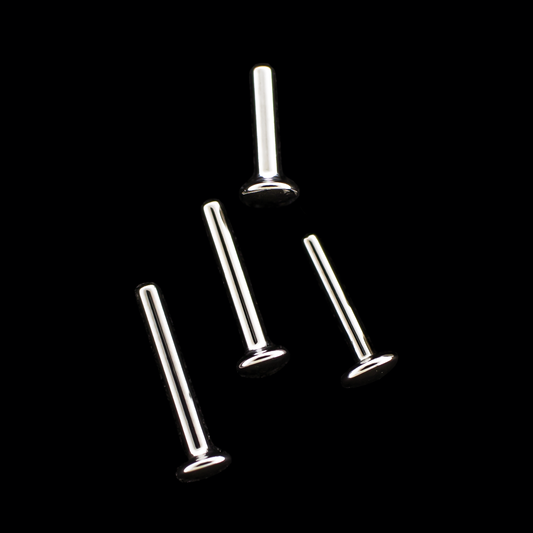
Titanium Threadless Labret Posts – ASTM F136 Flat Back Posts for Every Piercing
The post is the piece that never leaves your piercing. Every titanium threadless labret post in this collection is made from ASTM F136 implant-grade titanium by Khrysos Jewelry, machined to accept a standard 25G threadless pin for maximum compatibility across the industry. We carry the widest size selection available so you can find the exact fit for your anatomy without having to custom order.
What Is a Titanium Threadless Labret Post?
If you are new to flat back jewelry, here is exactly what you are buying and how it works before you choose your size.
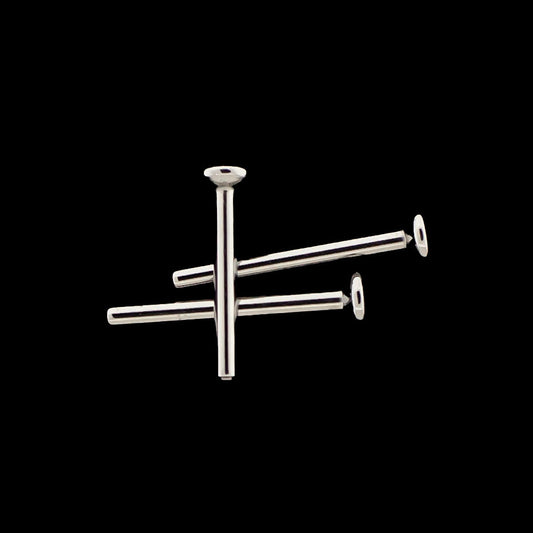
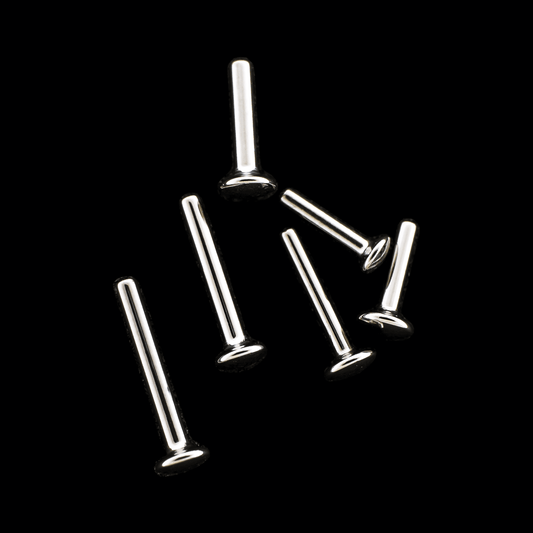
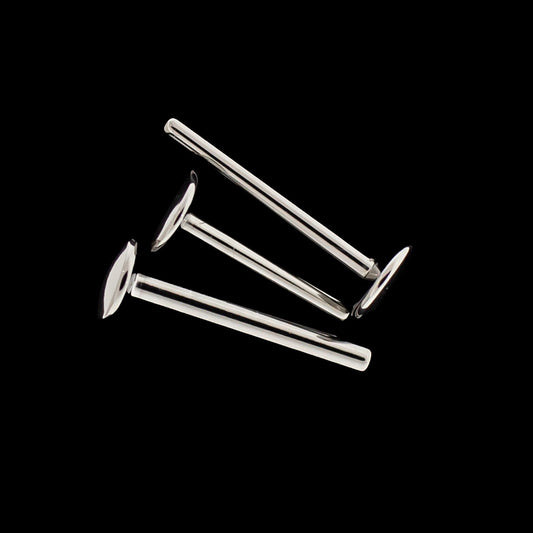
A titanium threadless labret post is the base component of a push-fit jewelry system. It is the piece that goes into your piercing and stays there. The post has a straight shaft with a flat disc on one end, which sits behind or inside the piercing, and a hollow opening at the other end that accepts the pin of a threadless decorative end. You push the end in to secure it and pull it straight out to remove it.
The flat disc design is what makes this style different from traditional butterfly-back jewelry. The disc sits flush and smooth against the skin or tissue behind the piercing, which means no sharp backs catching on hair, pillowcases, or clothing. For lip and oral piercings like labret, Monroe, and Medusa, the flat disc rests smoothly against the inner gum line, significantly reducing the friction and pressure that can damage tooth enamel and gum tissue over time with other jewelry styles.
Every post in this collection is machined to accept a standard 25G threadless pin. That measurement is the industry-wide standard used by the major threadless jewelry brands, which means our posts are compatible with most threadless ends you already own or will buy in the future.
See more: Titanium Flat Back Labret: Safe, Stylish Body Jewelry
Why ASTM F136 Titanium Is the Right Material for Your Labret Post
The post is the piece that stays in your piercing permanently, through healing and beyond. What it is made of matters more here than anywhere else in your jewelry setup.
ASTM F136 implant-grade titanium is the professional standard for labret posts, and the reasons come directly from how this piece is used. Because the post lives inside your piercing at all times, it needs to be completely inert, lightweight, and durable without any surface treatments that can degrade over time.
Ti-6Al-4V ELI titanium, the specific alloy classification used in all our posts, is 100% nickel-free. Nickel sensitivity is far more common than most people realize, and even a mild reaction in a piercing channel that never gets to fully rest can look like a chronic healing problem. Titanium eliminates that variable entirely. It is also significantly lighter than steel or gold, which matters especially for cartilage piercings where even small amounts of extra weight can create downward pressure on healing tissue and slow recovery.
Unlike plated or PVD-coated steel posts, ASTM F136 titanium can be anodized into colors including gold, rose gold, black, and rainbow at the molecular level with no coating that can chip or flake inside a healing channel. All posts in this collection are also fully autoclavable, meaning they can be sterilized to professional studio standards before any placement.
Khrysos Jewelry backs every ASTM F136 titanium piece with a lifetime workmanship guarantee. If a manufacturing defect occurs at any point, it is replaced.
Sizing Guide: How to Choose the Right Post for Your Piercing
Choosing the wrong post length is the most common and most easily avoided mistake when buying a titanium threadless labret post online. Here is a clear breakdown so you get it right the first time.
Post Length by Piercing Placement
The correct post length depends on the thickness of the tissue the post passes through. Here is a practical guide by placement:
Earlobe piercings (healed) typically fit best with a 5mm to 6mm post. Most lobe anatomies fall in this range for healed piercings. If you have thicker lobes or your piercing is still in the early healing phase, size up to 7mm.
Helix and forward helix piercings usually need 6mm to 7mm depending on how thick the cartilage is at that specific point. Thinner, flimsier cartilage may be comfortable with 5mm to 6mm, while denser cartilage near the helix rim often needs 7mm.
Tragus and conch piercings are among the thicker cartilage placements and generally require 7mm to 8mm for a properly fitted healed piercing. Some anatomies with particularly dense tragus cartilage need even more length during healing.
Nostril piercings (healed) most commonly fit 5mm to 6mm posts. Fresh nostril piercings need more length to accommodate swelling, typically 7mm to 8mm, and should be downsized once healed.
Lip, labret, and oral piercings including Monroe and Medusa placements generally require 6mm to 8mm depending on lip thickness. Thicker lips need longer posts, and fresh lip piercings always require additional length for the initial swelling period.
For any fresh or initial piercing, regardless of placement, always size up by at least 2mm from your anticipated healed length. That extra length is what allows the tissue to swell without the post embedding or causing pressure on the wound.
Back Disc Size: 2.5mm vs. 3mm vs. 4mm
The back disc is the flat circular piece that sits behind or inside the piercing. Its size affects both comfort and stability, and the right choice depends on your placement and anatomy.
A 2.5mm back disc is the smallest option and the most discreet. It sits very close to the skin with minimal profile. This size works well for thin lobes, healed nostril piercings, and any placement where you want the backing to be as invisible as possible. The tradeoff is that on a longer post or with thicker tissue, a smaller disc may not provide enough surface area to sit stably.
A 3mm back disc is the middle ground that works well for most ear cartilage piercings and a wide range of nostril anatomies. It offers more stability than the 2.5mm without the prominence of the larger 4mm option.
A 4mm back disc provides the most stability. The larger surface area distributes pressure more evenly against the tissue, which is particularly important for lip and oral piercings where the disc sits against the gum line, for tragus and conch piercings where the backing can press against the inside of the ear canal, and for anyone who has experienced issues with smaller discs sinking or embedding. For initial piercings and high-movement placements, the 4mm is the more practical choice.
The quick summary: 2.5mm for discreet everyday ear and nose wear, 3mm for general cartilage use, 4mm for lip piercings, high-movement placements, and thicker anatomies.
Best Piercing Placements for Titanium Threadless Labret Posts
A titanium labret threadless post is one of the most universally useful pieces of body jewelry you can own. Here is where it performs best.
Ear piercings are the most common and most natural home for flat back labret posts. From lobe to forward helix, tragus, conch, flat, and rook, the flat disc design keeps the backing sitting smooth against the inner ear without the points and edges of traditional earring backs. For side sleepers, this is particularly significant. The flat disc creates no pressure points against the pillow, making it the most comfortable option for overnight wear in cartilage piercings.
Nostril piercings benefit enormously from the titanium threadless labret system. L-shaped bars and nose screws rely on their shape to stay in place and can rotate, fall out, or sit unevenly. A flat back labret post is held in place by the end's tension fit, which means it stays exactly where it was placed. The flat disc inside the nostril causes no irritation to the mucous membrane lining, which is one of the most common causes of chronic nostril piercing irritation with other jewelry styles.
Lip and oral piercings including labret, Monroe, Medusa, and philtrum placements are where the flat back design has the most direct impact on long-term oral health. The flat disc sits smooth against the inner gum line rather than pressing a curved or pointed surface against enamel. For anyone who has experienced gum recession or enamel wear from oral jewelry, switching to a flat back titanium labret post is one of the most important upgrades you can make.
Shop Titanium Threadless Labret Posts
Every post in this collection is made from ASTM F136 titanium by Khrysos Jewelry with a lifetime workmanship guarantee. Posts are sold individually. Ends are sold separately.
For a discreet, everyday option, our Titanium Threadless Labret Post with 3mm back is the newest addition to the lineup. Made from solid stock ASTM F136 titanium and hand polished to a mirror shine, the 3mm disc offers a balance between discreteness and stability that works across a wide range of ear and nose placements. Available in multiple gauges and lengths. If you do not see the size you need, email us and we will work to add it.
For cartilage, lip, and oral piercings where stability matters most, the Titanium Threadless Labret Post with 4mm back is the right choice. Available in 16G and 18G, the larger disc distributes pressure evenly against tissue and reduces the risk of embedding in fresh or swollen piercings. Hand polished to a mirror finish from ASTM F136 titanium throughout.
For thicker anatomies, initial piercings, and deep-set placements where standard lengths fall short, the Extra Long Titanium Threadless Labret Post provides the additional length you need. If your piercer has told you standard posts are too short for your anatomy, this is the option. Custom sizes are also available on request.
Pair your post with a Titanium Threadless End to complete your push-fit setup.
Threadless vs. Internally Threaded Labret Posts: Which Is Right for You?
Both systems are professional-grade and available in ASTM F136 titanium. The right choice depends on how you use your jewelry and what your piercing needs.
Here is how the two systems compare on the factors that matter most for everyday use:
Threadless labret posts use a push-fit pin system where the end simply presses in and pulls out. Internally threaded labret posts use a screw-in end where the threading is inside the post for a smooth insertion. Both keep the smooth shaft in contact with your piercing channel, which is the critical safety advantage over externally threaded jewelry.
For changing ends frequently, threadless wins clearly. Swapping a threadless end takes five seconds with no twisting required. Internally threaded ends require careful alignment and screwing, which takes longer and requires more precision in tight spaces like the inside of the ear.
For directional alignment, threadless also has the advantage. When you set a threadless end on a curved post, you can orient it to face exactly the direction you want. Internally threaded ends on curved posts can rotate during tightening and end up facing sideways.
For maximum hold in high-movement placements like nipple piercings, or for large statement ends that need extra stability, internally threaded jewelry provides a more secure mechanical lock.
The practical summary: for ear stacking, nostril, and facial piercings where you rotate ends regularly, titanium threadless labret posts are the clearer choice. For nipple jewelry or placements that see consistent physical contact and movement, internally threaded is the stronger option. View our Titanium Internally Threaded Labrets for screw-in options in the same ASTM F136 titanium.
Why Buy Titanium Threadless Labret Posts from Pierced Addiction?
There are plenty of flat back labret posts on the market. Here is what makes ours worth choosing.
Every post in this collection is made from Ti-6Al-4V ELI titanium, the same alloy classification used in medical and surgical implants. It is not marketed as titanium but made from a lesser grade. The material is the same standard used in professional piercing studios, backed by a lifetime workmanship guarantee from Khrysos Jewelry.
Our posts are machined to a standard 25G pin hole, which means they accept threadless ends from most major brands. You are not locked into a proprietary system, and you do not need to replace your existing ends when you buy our posts.
We carry the largest selection of sizes in the collection, from standard lengths for healed piercings to extra long options for thicker anatomy and initial placements. If you still cannot find the size you need, we accept custom size requests by email. Free USPS economy shipping on all orders over $25, with same-day processing for orders received before 1PM.
Frequently Asked Questions About Titanium Threadless Labret Posts
Quick answers to the most common questions before you buy.
What length titanium threadless labret post do I need?
5mm to 6mm for healed lobes and nostrils, 6mm to 8mm for cartilage and lip piercings, and 8mm or extra long for fresh piercings that need room for swelling.
What is the difference between a 2.5mm and a 4mm back disc?
The 2.5mm is smaller and more discreet, best for lobes and nostril piercings. The 4mm disc provides more stability and is better suited for cartilage, lip, and oral placements.
Are your posts compatible with threadless ends from other brands?
Yes. Our posts accept standard 25G threadless pins, making them compatible with most major threadless end brands on the market.
Can I use a titanium threadless labret post in a fresh piercing?
Yes. ASTM F136 titanium is safe for fresh piercings. Use a longer post to allow room for swelling, and have a professional piercer perform the first jewelry change.
What gauge do I need for my threadless labret post?
18G is standard for most ear and nostril piercings. 16G is common for lip, tragus, and thicker cartilage placements. Confirm your gauge with your piercer before ordering a replacement.
Do the posts come with a threadless end included?
No. Posts are sold individually. Threadless ends are sold separately and can be mixed and matched from our titanium threadless ends collection.
Conclusion
The right titanium threadless labret post is the foundation of a comfortable, long-lasting piercing setup. Every post in this collection is made from ASTM F136 implant-grade titanium by Khrysos Jewelry, sized to fit real anatomy, and backed by a lifetime guarantee. Browse the full size range above and find your fit.