
Steel Internally Threaded Barbells | 316L Implant-Grade for Tongue, Nipple, Industrial and Cartilage Piercings
This collection features steel internally threaded barbells by Metal Mafia, crafted from 316L implant-grade steel with a mirror-polished, smooth post shaft. Designed for tongue, nipple, industrial, and cartilage placements, these barbells pair internally threaded construction with solid 316L steel at a price point below titanium. Available in 14G and 16G across multiple lengths, with removable and swappable ball ends.
What Are Steel Internally Threaded Barbells?
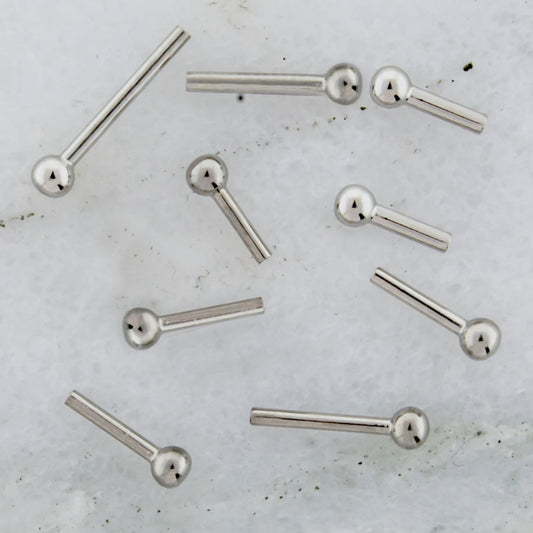
Steel internally threaded barbells are straight posts built from 316L implant-grade steel with a smooth exterior shaft and screw-in ball ends. The thread mechanism is contained inside the hollow tip of the post, with the screw pin built into the ball or decorative end rather than running along the outside of the shaft. When you insert the barbell, nothing but smooth 316L steel moves through the piercing channel. The ends then screw in from either side to lock in place against the skin.
This design makes steel internally threaded barbells the professional standard for straight barbell placements across the piercing industry. The smooth post surface matters especially for thick-tissue placements like tongue and nipple, where the barbell must pass through a significant depth of tissue on insertion and removal. Any external thread ridges on the shaft create friction and micro-abrasion at the channel walls each time the jewelry moves. Internal threading removes that contact entirely.
How Internal Threading Works
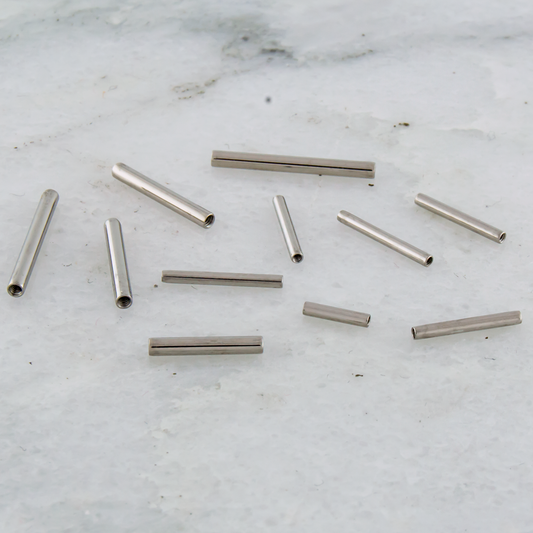
The post shaft of every steel internally threaded barbell in this collection is fully smooth and hollow at both ends. Each hollow tip contains internal thread grooves machined into the inside of the channel. The ball end carries a solid screw pin with external threads that match those grooves. To attach a ball, you align the pin with the hollow tip and turn clockwise until it seats firmly. To remove it, you turn counterclockwise. The mechanism is entirely inside the post, so no thread ridges are ever exposed on the shaft surface at any point during wear or during changes. This is the construction that makes a steel internally threaded barbell the correct choice for thick-tissue placements.
Internally Threaded vs Externally Threaded Barbells
On an externally threaded barbell, the thread ridges are cut directly into the shaft of the post near each end. When you insert the barbell, those ridges drag across the tissue inside the piercing channel. In a fully healed, thick-tissue placement the irritation is usually minor, but it is present on every insertion and removal. In a piercing that is still sensitive, still experiencing occasional tenderness, or healing slowly, externally threaded jewelry can cause micro-tears in the channel lining that prolong the healing process and increase the risk of irritation bumps.
Steel internally threaded barbells avoid this contact entirely. The shaft is smooth. The tissue in the channel contacts only polished 316L steel with no edges, ridges, or texture. For industrial placements, a steel internally threaded barbell contacts cartilage at two separate exit points simultaneously, the difference between smooth and threaded is particularly significant because cartilage heals more slowly than soft tissue and is less forgiving of repeated friction.
Which Piercings Use a Straight Barbell?
The steel internally threaded barbell is the most multi-placement form factor in piercing jewelry. The same basic design works across placements that differ substantially in gauge, length, tissue type, and healing time. Understanding which placement uses which gauge and length is the practical step that determines whether the barbell you order will actually work for your piercing.
Industrial Piercings
The industrial is the defining placement for a long steel internally threaded barbell. It passes through two cartilage points in the upper ear, typically helix to antihelix or flat to helix, requiring a barbell long enough to span both exit holes and sit flush against the ear without pulling at either end. Industrial piercings have a healing timeline of six to twelve months, and because the barbell contacts cartilage at two points simultaneously throughout that period, smooth post construction is more important here than in almost any other placement.
- Standard gauge: 14G across virtually all industrial piercings in US professional studios
- Standard lengths: 32mm, 35mm, and 38mm cover the majority of ear anatomies; 35mm is the most common fit
- Why internally threaded: thread ridges contacting the channel at either exit hole compound irritation over the full six to twelve month healing period
Tongue Piercings
Tongue piercings are pierced at 14G as the US industry standard. The tongue is dense vascular tissue that swells significantly in the first week, so the steel internally threaded barbell selected for initial placement must be long enough to avoid the ball ends pressing into the tissue surface. Once healed, downsizing to a shorter barbell reduces the risk of dental and gum contact that causes chipping and recession over time.
- Standard gauge: 14G
- Initial length: 7/8" (22mm) or 1" (25mm) to accommodate swelling
- Healed length: 5/8" (16mm) or 3/4" (19mm) depending on tongue thickness
- Ball size: 5mm minimum for top ball to prevent sinking; 6mm to 8mm is most common
Nipple Piercings
Nipple piercings use a 14G steel internally threaded barbell as the standard in most US professional studios. Initial length accounts for swelling and anatomy variance. Healed piercings typically downsize to a shorter length, as a long barbell in a healed nipple creates leverage that amplifies irritation from clothing contact throughout the day. Nipple piercings have a realistic healing timeline of nine to twelve months even with consistent aftercare.
- Standard gauge: 14G
- Initial length: 9/16" (14mm) or 5/8" (16mm) 3/4"(19mm) to accommodate swelling and anatomy
- Healed length: 1/2" (13mm) to 5/8" (16mm) depending on nipple diameter
Cartilage and Other Placements
Helix, conch, and bridge piercings can use a steel internally threaded barbell in 14G or 16G depending on the studio and anatomy. For helix and bridge, 16G is the more common gauge in US studios. Conch piercings may use either. For eyebrow and navel placements, a curved barbell is the anatomically correct choice rather than a straight post.
- Helix and bridge: 16G, length 5/16" (8mm) to 3/8" (10mm)
- Conch: 14G or 16G, initial 3/8" (10mm), healed 5/16" (8mm)
Gauge and Length Guide
The gauge of your steel internally threaded barbell must match your existing piercing channel exactly. A 14G barbell will not fit a 16G channel without force, and a 16G barbell will sit loose in a 14G channel. Length is measured as the straight-line distance between the two ends of the post, not including the balls. Ordering the correct length for your piercing status, whether fresh or healed, prevents the two most common fit problems: a barbell too long that snags and moves excessively, and one too short that creates pressure on the entry and exit holes.
14G placements and standard lengths:
- Industrial: 32mm, 35mm, or 38mm depending on ear anatomy. When in doubt, 35mm fits the majority of ear anatomies
- Tongue (initial): 7/8" (22mm) or 1" (25mm) to allow for swelling in the first week
- Tongue (healed): 5/8" (16mm) or 3/4" (19mm) depending on tongue thickness
- Nipple (initial): 9/16" (14mm) or 5/8" (16mm) to accommodate swelling and anatomy
- Nipple (healed): 7/16" (11mm) to 1/2" (13mm) depending on nipple diameter
16G placements and standard lengths:
- Helix and bridge: 5/16" (8mm) to 3/8" (10mm) for most placements
- Conch: 3/8" (10mm) initial, 5/16" (8mm) healed
If you are not sure which steel internally threaded barbell gauge or length fits your anatomy, ask your piercer before ordering. Downsizing from an initial length to a healed length should always be done at a studio, not at home, to avoid disturbing a piercing that is close to but not yet fully healed.
Steel vs Titanium: Which Should You Choose?
Both 316L surgical steel and ASTM F136 titanium are implant-grade materials safe for body jewelry. The choice between them comes down to three practical factors: the status of the piercing, sensitivity concerns, and budget.
For fully healed piercings with no history of metal sensitivity, 316L steel internally threaded barbells deliver reliable and cost-effective option. Every steel internally threaded barbell in 316L is formulated to minimize nickel release, takes a mirror polish that holds up to daily wear and regular cleaning, and maintains the precision-machined thread tolerances that allow consistent end engagement over repeated changes. For piercings that are still healing, or for anyone with a known nickel sensitivity or a history of reactions to steel jewelry, ASTM F136 titanium is the stronger recommendation. Titanium contains no nickel in any form, is significantly lighter than steel (which matters for industrial piercings where the barbell spans two exit points and its weight creates pull on the cartilage throughout the day), and can be anodized to produce a range of colors without affecting biocompatibility.
For placements that require a curved shape rather than a straight post, the Steel Internally Threaded Curved Barbells collection covers eyebrow, rook, navel, and daith in the same 316L implant-grade steel.
Are the Ends on These Barbells Swappable?
Yes. Every steel internally threaded barbell in this collection has ball ends that unscrew and can be replaced with any compatible internally threaded ends at the matching gauge. A 14G barbell accepts 14G internally threaded ends. A 16G barbell accepts 16G internally threaded ends. The two gauges use different thread dimensions and are not interchangeable.
This means you can change the look of a piercing by replacing the ball end on your steel internally threaded barbell with a CZ gem end, an opal disc, a flat disc, or any other internally threaded end style without removing the shaft from the piercing itself. For tongue piercings, changing only the top ball on a steel internally threaded barbell rather than the entire piece reduces the amount of movement in the channel during a jewelry change. For industrial piercings, the ability to swap one or both end balls without disturbing the shaft is useful for maintaining the piercing during long healing periods without being locked into a single ball style for months.
Browse compatible screw-in tops in CZ, opal, flat disc, and shaped styles in the Steel Internally Threaded Ends collection at matching 14G and 16G gauges.
Why Shop Steel Internally Threaded Barbells at Pierced Addiction?
Every steel internally threaded barbell at Pierced Addiction comes from Metal Mafia, a supplier that produces to professional piercing industry tolerances. The 316L steel is solid throughout with no plating over base metal. The mirror polish is consistent and holds up to saline aftercare cleaning and regular wear without dulling. The thread pins on the ball ends are machined to match the internal grooves of the post precisely, so ends seat cleanly on the first try without cross-threading or over-tightening.
- 316L implant-grade steel, solid construction with no plating or coating over base metal
- Smooth post shaft, no thread ridges on the exterior surface at any point along the barbell
- Multiple gauges and lengths, 14G and 16G across a full range of lengths for industrial, tongue, nipple, and cartilage placements
- Swappable ball ends, compatible with all standard internally threaded ends at matching gauge
- Same-day processing for domestic orders received before 1PM
- 7-day quality guarantee on all items in original sealed packaging
Frequently Asked Questions
What gauge is a steel internally threaded barbell for tongue piercing?
14G is the standard for tongue piercings in US professional studios. If you are replacing an existing barbell, match the gauge of your current jewelry exactly before ordering.
What length do I need for an industrial barbell?
32mm, 35mm, and 38mm cover the majority of ear anatomies. If you are unsure, 35mm is the most common fit. Have your piercer measure your ear before ordering a replacement.
Can I use a steel internally threaded barbell for a fresh piercing?
316L is implant-grade but ASTM F136 titanium is the professional recommendation for fresh piercings due to its nickel-free composition and superior biocompatibility. Steel internally threaded barbells are best for fully healed placements.
What is the difference between internally and externally threaded barbells?
Internally threaded has a smooth shaft; thread grooves are inside the hollow post tip only. Externally threaded has ridges on the outside of the shaft that contact the piercing channel on every insertion and removal.
Are the ball ends on these barbells replaceable?
Yes. The balls unscrew and can be replaced with any compatible internally threaded ends at the matching gauge. A 14G barbell takes 14G ends. A 16G barbell takes 16G ends. The two gauges are not interchangeable.
What is the longest length available for nipple barbells?
This collection includes lengths up to 1 1/2 inches (38mm) in 14G, which covers initial nipple piercings in all anatomies. Confirm the exact range on the product page for your gauge before ordering.
Shop Steel Internally Threaded Barbells
Steel internally threaded barbells in this collection cover 14G and 16G across multiple lengths for tongue, nipple, industrial, and cartilage placements. All 316L implant-grade from Metal Mafia, smooth post construction, with removable ball ends compatible with the full internally threaded ends system. For a comparison with externally threaded options, see our Externally Threaded Barbells collection.