



Steel Captive Bead Rings | 316L Implant-Grade CBRs for Septum, Cartilage, Nipple and More
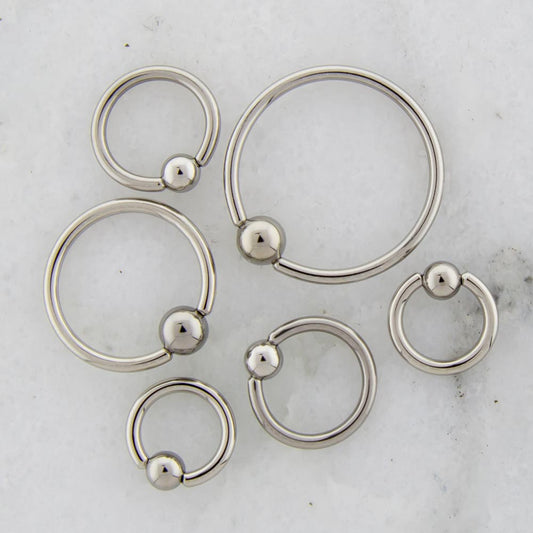
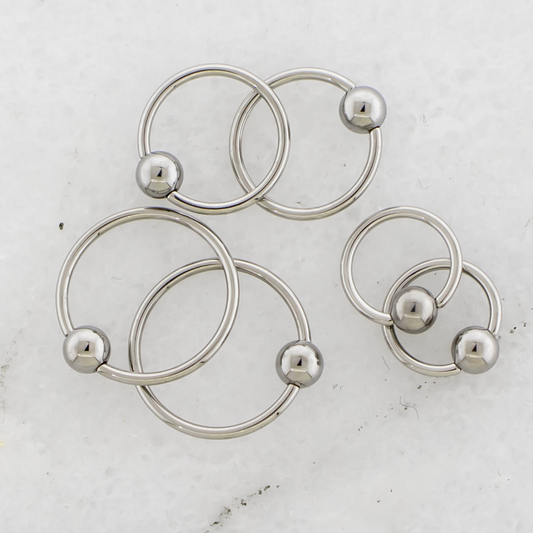
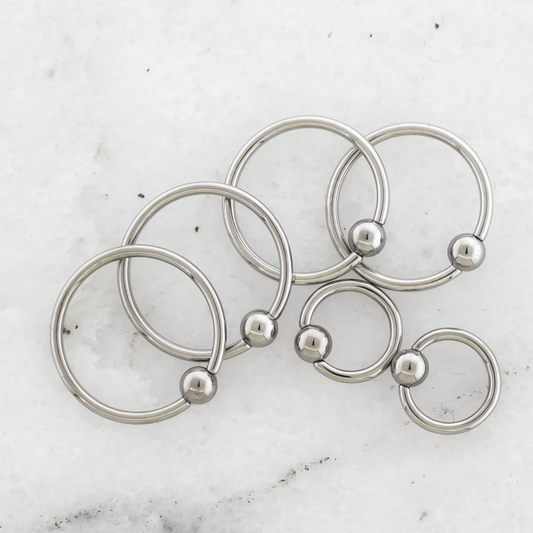
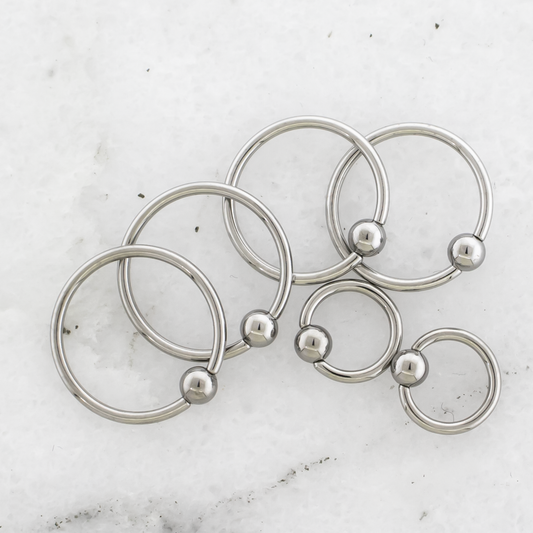
This collection brings together steel captive bead rings made from 316L implant-grade surgical steel, hand-polished to a mirror finish and available in gauges from 20G to 00G. Diameters range from 6mm through 22mm to cover septum, cartilage, daith, nipple, and large-gauge placements. PVD color finishes are available across select styles. All steel captive bead rings in this collection are designed for fully healed piercings. Free shipping on orders over $25.
What Are Steel Captive Bead Rings?
A captive bead ring made from 316L surgical steel holds a single bead in place using the tension of the ring itself. The ring ends press into small dimpled indentations on either side of the bead, and the bead is held in position by that inward pressure. No hinge, no screw, no locking mechanism. The bead is simply captured by the ring tension, which is where the name comes from.
CBR vs Segment Ring vs Seamless Ring: What Is the Difference?
These three ring styles look similar from a distance but open and close through completely different mechanisms. Understanding which type you have, or which type you are ordering, avoids the most common source of confusion when buying ring-style body jewelry.
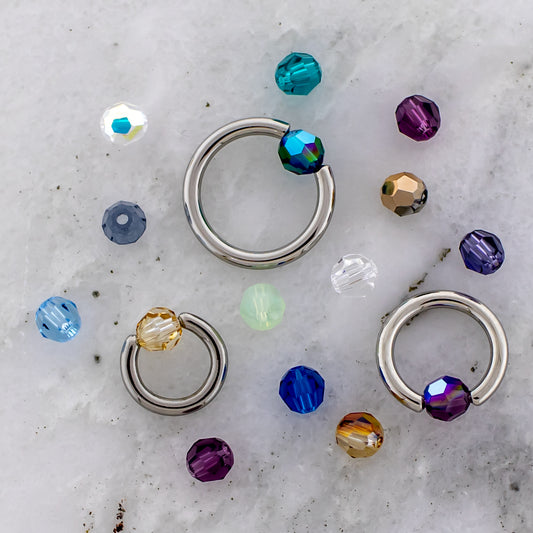
A steel captive bead ring has a separate bead that is held by ring tension. The bead can be removed and replaced with any compatible bead at the same gauge, which makes CBRs the most customizable of the three formats. The bead can be plain, gem-set, or shaped. A segment ring has a small section of the ring itself that lifts out as a removable piece, leaving a gap for insertion.
There is no separate bead and the closure is the ring material itself, which produces a very clean, continuous look once closed. A seamless ring is a continuous circle that twists open at one point for insertion and then twists back closed. There is no separate piece at all. The seamless ring is the cleanest visual option but requires some practice to open and close smoothly.
For anyone who wants to swap bead styles across the same ring, a CBR is the practical choice. For anyone who prioritizes the cleanest possible ring look with no visible closure, segment or seamless styles are the alternative.
Which Piercings Use Steel Captive Bead Rings?
Steel captive bead rings are appropriate for fully healed piercings across a wide range of placements. The circular geometry creates lateral movement in the channel during activity, which a healed fistula handles comfortably. Piercers recommend a barbell or flat-back labret for the healing period before transitioning to a CBR once the piercing is established.
Septum and Cartilage Piercings
The septum is one of the most common placements for a steel captive bead ring. The circular format of the CBR follows the natural curve of the septum tissue, and the horseshoe alternative to a CBR can be flipped up inside the nostrils, but a CBR at the septum creates a classic ring look that sits below the columella. 16G is the standard septum gauge, with 8mm inner diameter fitting most anatomies. Wider septum anatomy typically suits 10mm.
For ear cartilage placements, steel captive bead rings work well in daith, rook, helix, and conch piercings. Daith piercings particularly suit the CBR format because the ring follows the fold of the inner ear anatomy and the circular shape frames the daith naturally. Standard gauge for most cartilage CBR placements is 16G or 14G, with 8mm to 10mm covering most ear anatomies.
- Septum: 16G standard, 8mm most common inner diameter, 10mm for wider anatomy
- Daith and rook: 16G, 8mm to 10mm inner diameter
- Helix and conch: 16G or 14G, 8mm to 10mm
Nipple Piercings
Nipple piercings use a 14G straight barbell during the initial healing period, but a CBR is one of the two main style options for fully healed nipple piercings, alongside the straight barbell. The ring format gives nipple piercings a circular aesthetic that reads differently from the linear barbell look. Standard sizing for nipple CBRs is 14G at 10mm to 12mm inner diameter, with 12mm being the most common fit for most nipple anatomies.
The downward weight of a ring creates more pressure on the lower exit point than a barbell does, which is why most piercers recommend completing the initial healing phase with a barbell before transitioning to a ring.
Nose and Facial Piercings
For nostril piercings, steel captive bead rings in 18G or 20G at 6mm to 8mm inner diameter give a ring look that sits close against the nostril. The CBR format is less common for nostril piercings than screw or L-shape studs, but it is a valid style choice for fully healed nostrils where a ring aesthetic is preferred. Eyebrow piercings can use a small CBR at 16G in 8mm to 10mm diameter, though a curved barbell remains the most common choice for eyebrow placements due to the anatomical fit.
Steel Captive Bead Ring Sizing Guide
Gauge and inner diameter are the two sizing variables that determine whether a captive bead ring will fit your piercing correctly. Gauge must match the diameter of your existing piercing channel. Inner diameter determines how the ring sits against the anatomy: too small and the ring presses into the skin on both sides, too large and the ring hangs loosely and moves excessively.
- Septum: 16G, 8mm standard, 10mm for wider anatomy
- Daith, rook, helix, conch: 16G or 14G, 8mm to 10mm
- Nostril: 18G or 20G, 6mm to 8mm
- Eyebrow: 16G, 8mm to 10mm
- Nipple: 14G, 10mm to 12mm
- Large gauge (12G to 00G): 12mm to 22mm depending on gauge and anatomy
If you are unsure of the correct inner diameter, measure the inner diameter of your current ring jewelry before ordering. If you are between two sizes, sizing up by 1mm is more comfortable than sizing down, as a slightly larger ring moves more freely and does not press against the piercing site.
How to Insert and Remove a Steel Captive Bead Ring
For smaller gauges, inserting and removing the bead on a captive bead ring is straightforward. The ring must be opened just enough to release the bead without deforming the circle. The bead then aligns with the ring ends and snaps back into place under ring tension.
Small-Gauge CBRs: 20G to 14G
For captive bead rings in the 20G to 14G range, hand manipulation is sufficient for most people. Hold the ring firmly with both hands, one on each side of the gap, and apply gentle outward pressure to widen the opening slightly. The bead will release with a small pop. To insert a new bead, align the bead dimples with the ring ends and apply gentle inward pressure until the bead snaps into place. A rubber grip cloth or latex gloves improve grip on the bead surface if it slips.
Large-Gauge CBRs: 12G and Heavier
For captive bead rings at 12G and heavier, the ring metal is thick enough that hand pressure alone is not sufficient to open or close the ring without risking deformation or discomfort. Ring opening pliers and ring closing pliers are the correct tools for this gauge range. Opening pliers insert into the ring gap and spread outward to widen it. Closing pliers grip both sides of the ring and compress inward to close it. Using the correct tools prevents the ring from being opened too far, which can permanently alter the circular shape.
For ring manipulation tools, see the Piercing Tools collection for ring opening and closing pliers in the correct size range for 316L steel captive bead rings.
316L Steel vs Titanium for Captive Bead Rings
Both 316L surgical steel and ASTM F136 implant-grade titanium captive bead rings are available at Pierced Addiction, and both are appropriate materials for fully healed piercings. The choice between them comes down to nickel content, weight, color options, and price.
For most people with healed piercings and no active nickel sensitivity, 316L steel performs reliably. For anyone with a known nickel sensitivity or a history of reactions to steel jewelry, titanium captive bead rings are the correct choice because ASTM F136 titanium contains zero nickel. Titanium is also approximately 60 percent lighter than steel, a noticeable difference in nipple and large-gauge placements where ring weight creates pull throughout the day.
For the full titanium CBR range in ASTM F136 with anodized color options, see the Titanium Captive Bead Rings collection.
Why Shop Steel Captive Bead Rings at Pierced Addiction?
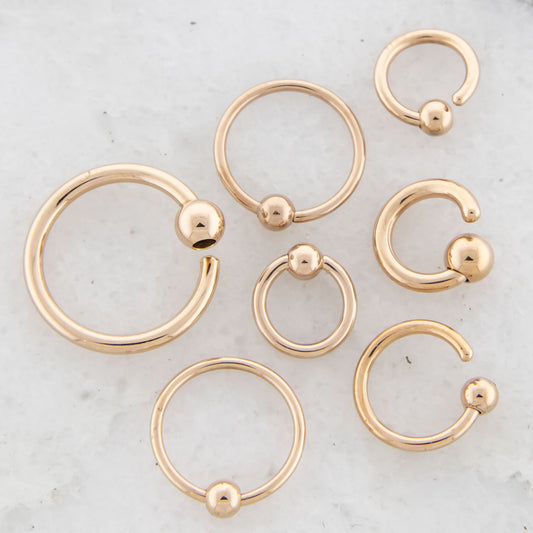
Every CBR in this collection is made from 316L implant-grade surgical steel and hand-polished to a mirror finish. The gauge range runs from 20G through 00G, covering fine jewelry placements at one end of the spectrum and large-gauge placements at the other. PVD black and select color finishes are available across specific styles for wearers who prefer a non-silver look without moving to titanium.
- 316L implant-grade steel: solid construction, no plating over base metal, mirror-polished finish
- Gauge range 20G to 00G: covers nostril through large-gauge placements in a single collection
- PVD color finishes: available on select styles for a non-silver look without changing materials
- Free USPS economy shipping on all orders over $25, all orders fully insured
- Same-day processing for domestic orders received before 1PM
- 7-day quality guarantee on all items in original sealed packaging
Pierced Addiction carries a full range of body piercing jewelry and aftercare products. Visit the Pierced Addiction to browse all collections across titanium, steel, and gold categories.
Frequently Asked Questions
Are steel captive bead rings safe for fresh piercings?
No. Ring movement in the piercing channel slows healing and causes irritation. Use a straight barbell or flat-back labret during healing and transition to a steel captive bead ring once fully healed.
What diameter CBR do I need for my septum?
8mm inner diameter fits most septum anatomies. If your current septum jewelry is larger or your anatomy is wider, 10mm is the next size up. Measure your existing jewelry before ordering to confirm.
Do I need pliers to open or close a captive bead ring?
For 20G to 14G, hand pressure and a good grip are usually sufficient. For 12G and heavier, ring opening and closing pliers are recommended to avoid deforming the ring when manipulating the bead.
What is the difference between a CBR and a segment ring?
A CBR holds a separate bead using ring tension. A segment ring has a small removable section of the ring itself as the closure, with no separate bead. Segment rings have a cleaner, continuous look. CBRs allow bead style swaps.
What gauges are steel captive bead rings available in?
This collection covers 20G through 00G. Standard piercings use 14G to 20G. Large-gauge placements use 12G through 00G. Match your existing piercing gauge exactly.
Can I replace the bead on my CBR with a different style?
Yes, as long as the replacement bead is the correct gauge and has the matching dimple configuration to sit securely in the ring ends. Bead diameter must be compatible with the ring gauge for the tension fit to hold correctly.
Shop Steel Captive Bead Rings
Captive bead rings in this collection cover 316L implant-grade steel across 20G to 00G in diameters for septum, cartilage, nipple, and large-gauge placements. Hand-polished with PVD options available. For a no-bead ring alternative in the same 316L steel, see the Steel Seamless Rings collection.