
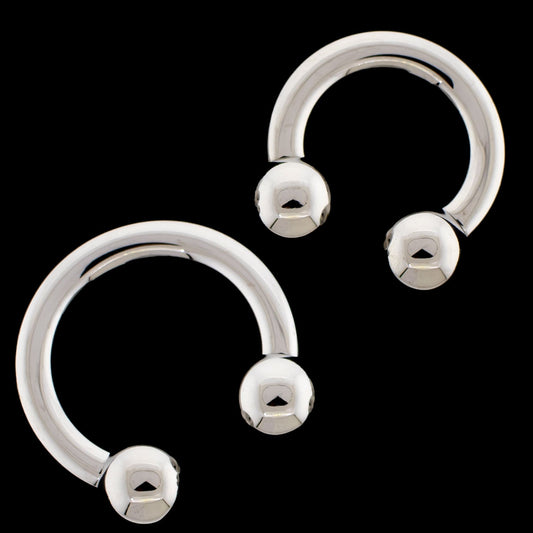
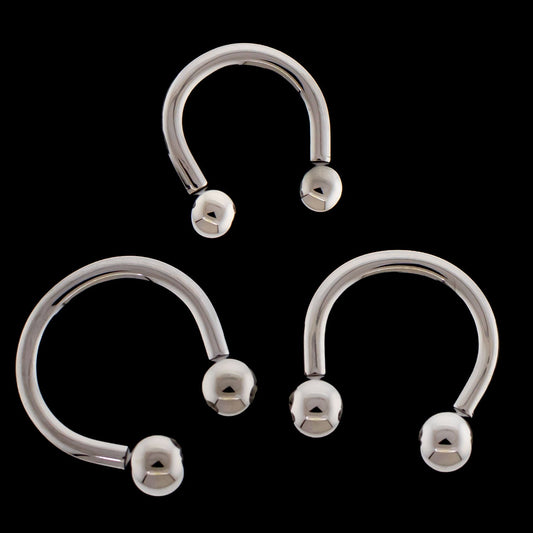
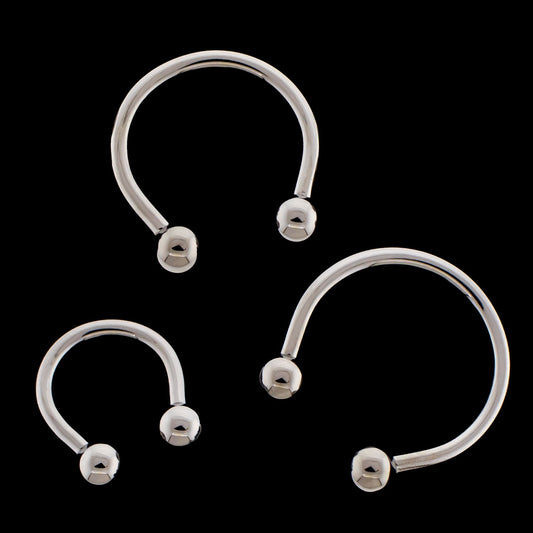
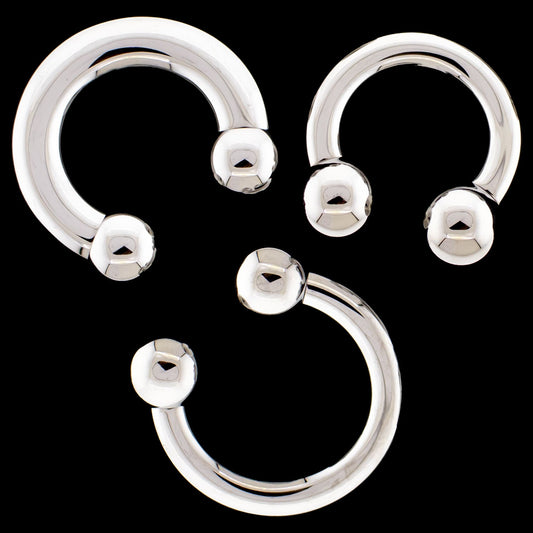
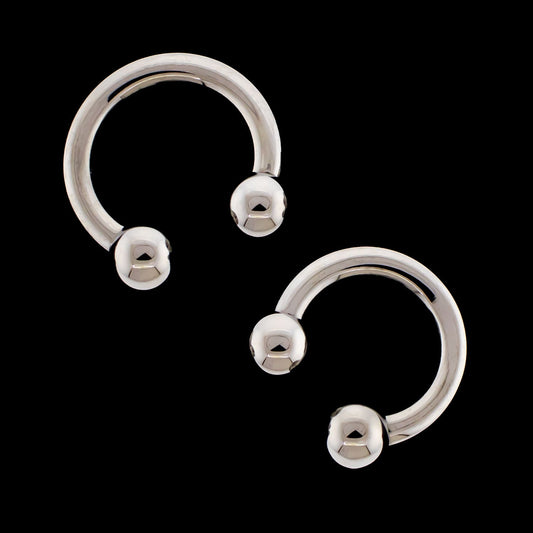
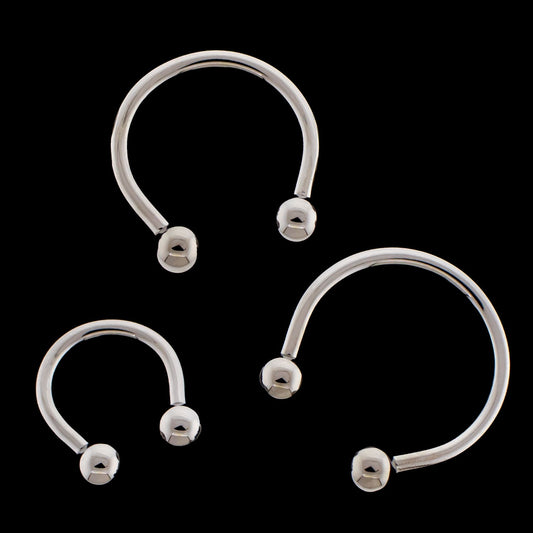
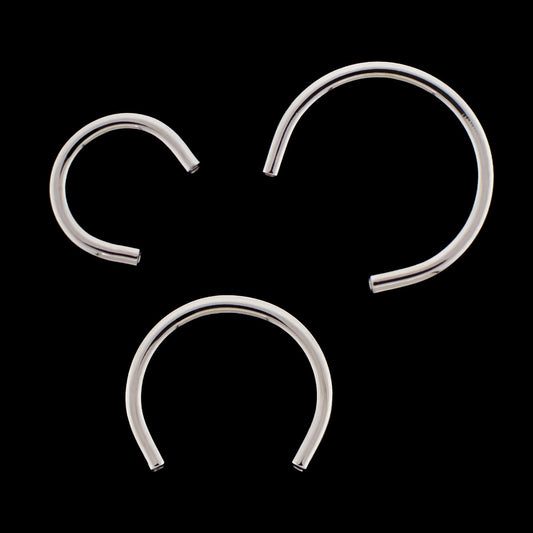
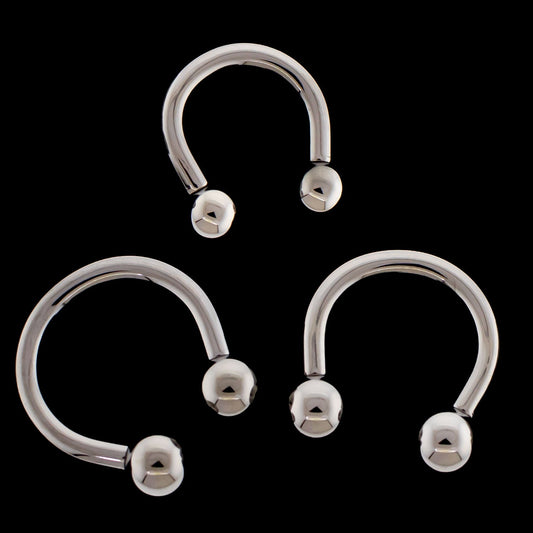
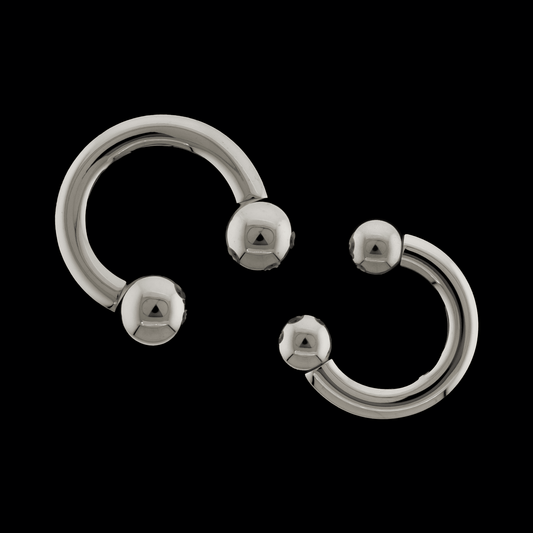
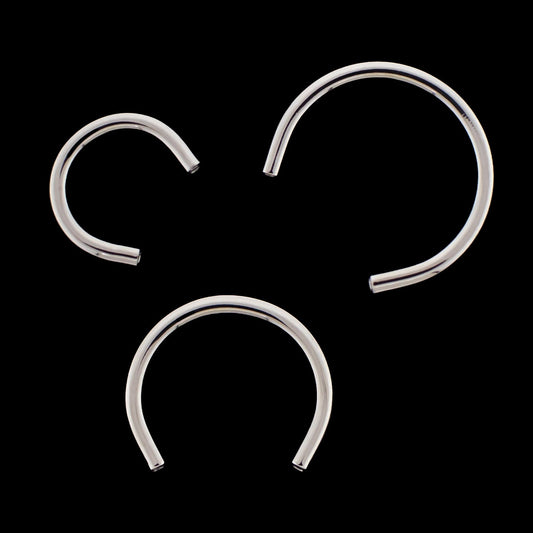
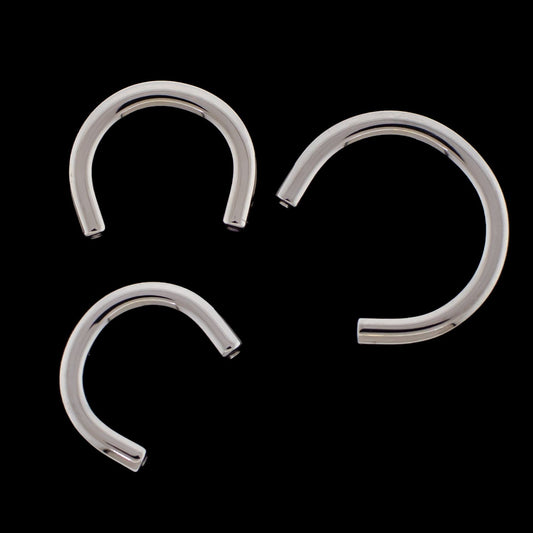
Internally Threaded Titanium Circular Barbells, ASTM F-136 by Khrysos
Khrysos ASTM F-136 titanium internally threaded circular barbells cover septum, nipple, lobe, lip, and cartilage placements across a wide gauge and diameter range. Smooth hollow shaft, zero nickel, anodizable in multiple colors. If you do not see your size listed in the collection above, contact us, the range is extensive and custom sizes are accommodated.
What Is a Circular Barbell, and How Is It Different from Other Ring Styles?
"Circular barbell," "horseshoe barbell," and "horseshoe ring" all refer to the same jewelry form: a U-shaped bar with a removable ball at each end. Understanding how this differs from other ring styles prevents ordering the wrong jewelry type for your placement.
Circular Barbell vs. Captive Bead Ring vs. Seamless Ring vs. Clicker
All four are ring-style jewelry types, but they open, close, and size differently:
- Circular barbell (horseshoe barbell): U-shaped bar with screw-in balls at each end. Fully removable ends mean the jewelry opens completely for insertion and diameter is adjustable by swapping ball sizes. The most size-flexible ring style.
- Captive bead ring (CBR): A complete circle with a single bead that snaps into a gap. No threads, no screws. Opens by springing the bead out.
- Seamless or segment ring: A complete circle that opens at a hidden seam. Harder to open and close, with no removable ends.
- Clicker or hinged ring: Opens via a hinged segment that clicks closed. Easiest to insert and remove, popular for daith and septum.
For septum piercings especially, the internally threaded horseshoe is the most practical everyday option because it can flip up into the nose when the jewelry should not be visible.
Placements for Internally Threaded Circular Barbells
The circular barbell is one of the most placement-versatile jewelry forms in body piercing. The same U-shape serves very different anatomical contexts depending on how gauge and diameter are selected for each placement.
Septum Piercing
The septum is the dominant placement for internally threaded circular barbell searches and the most diameter-sensitive piercing of all. The horseshoe hangs below the nose in a U-shape with both balls visible at the front, and the diameter determines both how low it hangs and how wide it sits against the face.
Standard gauge is 16G, with some piercers using 14G for thicker septum tissue.
Diameter for septum is typically 8mm for a tighter more discreet look, 10mm for a standard hang, and 12mm for anatomy with more space between the nostrils.
Titanium is the preferred material for septum because the piercing sits in a high-moisture environment where nickel-containing steel produces elevated irritation rates.
Nipple Piercing
Horseshoe barbells are a popular alternative to straight barbells for nipple piercings, particularly for wearers who prefer the look of a ring around the nipple rather than a bar across it.
Standard gauge is 14G. Diameter for nipple horseshoe barbells is typically 12mm to 14mm, with larger anatomy requiring 16mm.
The open horseshoe design allows cleaning access around the full circumference of the nipple, which is a practical advantage during the 6 to 18 month healing period.
Lobe, Lip, and Cartilage Placements
Stretched lobe piercings frequently use large-gauge horseshoe barbells as an alternative to plugs or tunnels, with the horseshoe style providing front and back visibility.
Lip piercings including lower lip and snake bites use 16G or 14G circular barbells at 8mm to 10mm diameter.
Daith piercings can accommodate circular barbells at 16G and 10mm to 12mm depending on the depth and curve of the inner ear cartilage fold. For daith and rook placements that suit a curved profile, internally threaded curved barbells are an alternative worth considering.
Sizing Guide, Gauge, Diameter, and Ball Size
This jewelry type is measured differently from straight or curved barbells. The key measurement is diameter, not length. Getting this distinction clear before ordering prevents the most common sizing mistake in this category.
How Diameter Is Measured
Diameter is the straight-line distance between the innermost points of the two open ends of the U-shape, measured from inner edge to inner edge across the widest point. It does not include the balls. A 10mm diameter horseshoe is 10mm across the inside of the horseshoe.
Buyers who measure the outer width of their current jewelry, or who include the balls in the measurement, will consistently order too large. If you are unsure of your diameter, bring your current jewelry to a piercer for measurement, or use a digital caliper across the inner opening.
Gauge and Diameter by Placement
Standard references by placement: septum piercings use 16G at 8mm (discreet) to 10mm (standard hang) to 12mm (wider anatomy). Nipple piercings use 14G at 12mm to 14mm, with 16mm for larger anatomy. Stretched lobe gauge matches the stretch size, with diameter typically 10mm to 14mm. Lip and snake bite piercings use 16G or 14G at 8mm to 10mm. Daith piercings use 16G at 10mm to 12mm depending on inner ear anatomy.
These are standard references. Individual anatomy varies considerably, and your piercer's original gauge should always be matched exactly. For stretched placements, always match gauge to your current stretch size exactly.
Ball Size
Ball diameter affects both the visual weight of the jewelry and how securely the ends stay seated.
For septum piercings, 3mm balls create a subtle minimal look while 4mm to 5mm balls are more visible and traditional.
For nipple circular barbells, 4mm to 5mm balls provide adequate visual presence and prevent the ends from sitting too close to the nipple edge.
For lobe and lip placements, ball size is largely an aesthetic decision within the range your gauge supports.
Why Choose Khrysos for Internally Threaded Circular Barbells at Pierced Addiction
Not all titanium horseshoe barbells deliver on their material claims. The gap between genuine ASTM F-136 and plated steel labeled as titanium shows up most clearly in placements like septum where jewelry is in constant contact with moist tissue. Here is what Pierced Addiction deliver:
- ASTM F-136 titanium, Ti6Al4V ELI, zero nickel by composition. Not a coating, not a plating. This is the exact specification the APP requires for initial and healing jewelry. For septum piercings in a high-moisture environment, nickel-free by composition is a meaningful distinction from plated steel or vaguely labeled "surgical grade" alternatives.
- Smooth internally threaded shaft throughout. No external threads contact tissue during any insertion or jewelry change. Thread tolerances are machined to consistent specs so balls seat cleanly without cross-threading or stripping over repeated use.
- True anodization, not PVD coating. Khrysos color options including high-polish silver, gold, rose gold, black, purple, teal, and blue are produced by electrochemically modifying the titanium surface oxide layer. The color is part of the metal itself and cannot peel or chip during wear.
- Wide size range, with custom accommodation. Pierced Addiction stocks Khrysos circular barbells across an extensive gauge and diameter range. If your size is not listed, reach out directly, custom sizes are accommodated.
For the full Khrysos internally threaded titanium lineup, the titanium internally threaded collection covers every form factor from labrets to curved barbells. For compatible internally threaded ends at matching thread tolerances, the internally threaded ends collection covers gem sets, opals, and shaped tops.
Frequently Asked Questions About Internally Threaded Circular Barbells
The questions below address the most common concerns before purchasing an internally threaded circular barbell from Pierced Addiction.
What is an internally threaded circular barbell?
A U-shaped bar with balls that screw in via a small pin inside the bar end. The shaft is completely smooth, so no threads contact tissue during insertion.
What diameter circular barbell do I need for my septum?
8mm for a discreet fit, 10mm for a standard hang, and 12mm for wider anatomy. Confirm with your piercer, as septum anatomy varies significantly between individuals.
How is circular barbell diameter measured?
From the inner edge of one open end to the inner edge of the other, across the widest point of the U. The balls are not included in this measurement.
What is the difference between a circular barbell and a captive bead ring?
A horseshoe barbell opens fully via screw-in balls for insertion. A captive bead ring has a single snap-in bead with no screws. The horseshoe style is easier to adjust.
What gauge is standard for a septum circular barbell?
16G (1.2mm) is the most common septum gauge. Some piercers use 14G for thicker tissue. Always match the gauge your piercer originally used.
Is ASTM F-136 titanium safe for a healing septum?
Yes. ASTM F-136 titanium is nickel-free and APP-recommended for all healing piercings. It is particularly suited to high-moisture placements like septum where nickel-containing steel produces elevated reaction rates.
Khrysos ASTM F-136 titanium internally threaded circular barbells at Pierced Addiction cover septum, nipple, lobe, lip, and cartilage placements across a wide gauge and diameter range. Confirm your gauge and diameter from the sizing guide above. If your specific size is not listed in the collection, contact us and we will accommodate your order.