




316L Stainless Steel Rings: Captive, Seamless & Hinged Rings for Every Piercing
316L implant-grade stainless steel rings cover the full spectrum of body piercing placements in a single collection. Whether you need a captive bead ring for a cartilage placement, a seamless ring for a nostril or daith, or a hinged clicker for a septum, this collection of stainless steel rings has the gauge, diameter, and finish to match. Every stainless steel ring here is made from 316L implant-grade steel built for long-term daily wear. From the most basic 20G seamless nose ring to a decorative 14G stainless steel septum ring, the collection covers the practical range of ring placements.
Ring Types in This Collection
Stainless steel rings for body piercing fall into three distinct types based on how they open, close, and sit against the piercing. Choosing the right stainless steel ring type for your placement makes a real difference in how easy the jewelry is to insert, how it looks when worn, and how securely it stays in place.
Captive Bead Rings
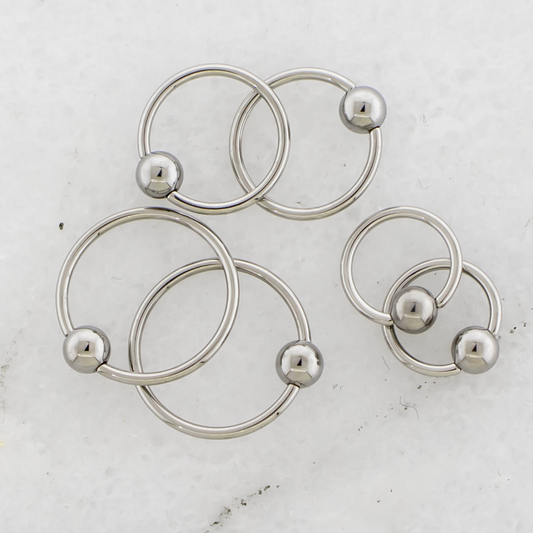
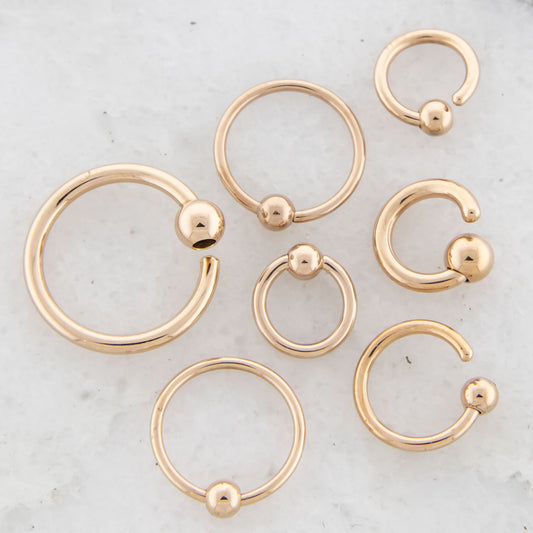
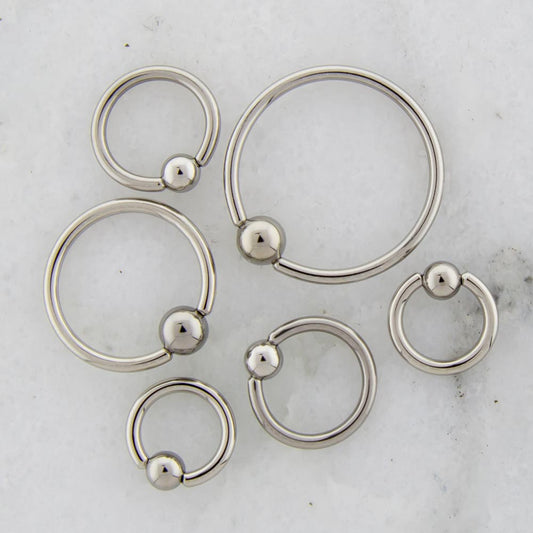
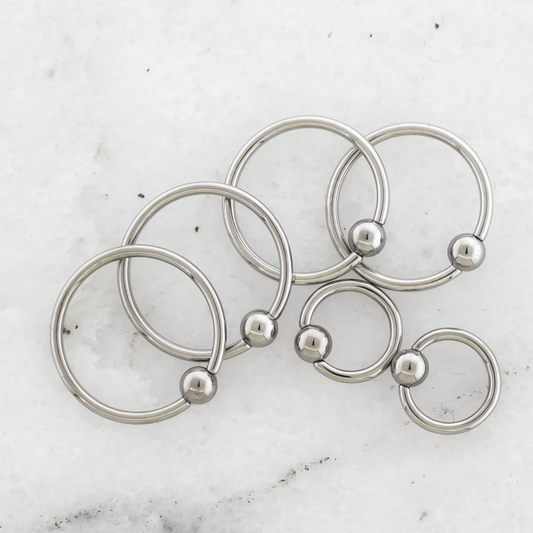
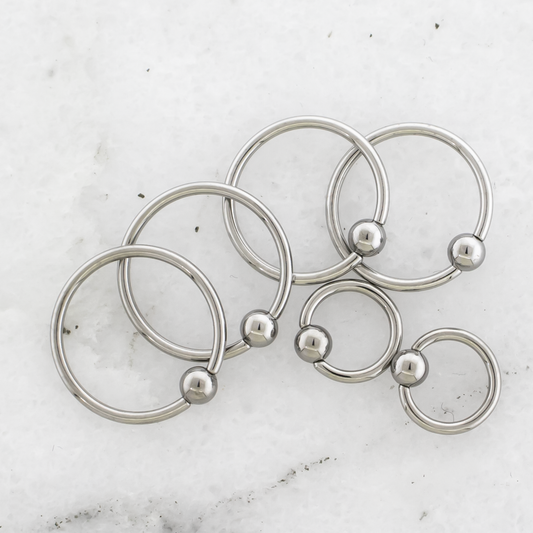
A captive bead ring is an open circular ring held closed by a single bead or ball that rests in tension between the two ends of the ring. The ball has small dimples on either side that align with the ring tips, and the pressure of the ring keeps it in place. Stainless steel captive bead rings in this collection are annealed, which means the steel has been heat-treated to soften it slightly, making the ring easier to open and close without the need for tools. Captive bead rings are the most versatile stainless steel ring type in this collection and work across nearly every placement including ear cartilage, helix, septum, nose, eyebrow, lip, and nipple piercings. The captive stainless steel ring is also the easiest to resize by swapping to a different diameter ball.
Seamless Rings
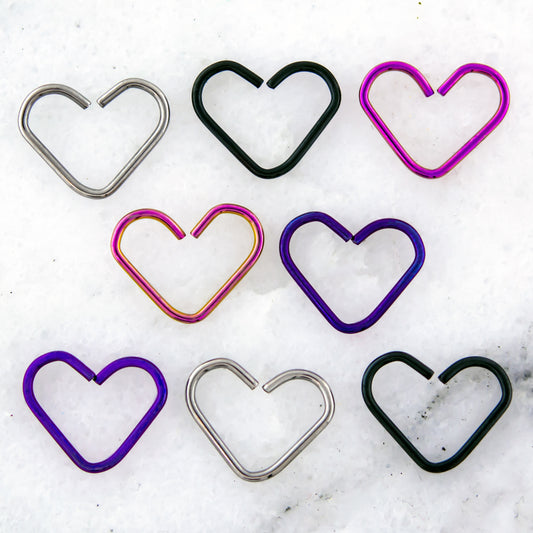
A seamless stainless steel ring is a continuous circle with a single cut through the ring body. There is no ball or separate piece. To open the ring, you twist the two cut ends in opposite directions; to close it, you twist them back until the seam aligns. Stainless steel seamless rings in this collection are also annealed for easier manipulation. The seamless design creates a low-profile, visually continuous ring with no hardware visible from the front, making these rings particularly well-suited to nostril, daith, helix, and septum piercings where a clean, minimal look is the goal.
Hinged Segment Rings (Clickers)
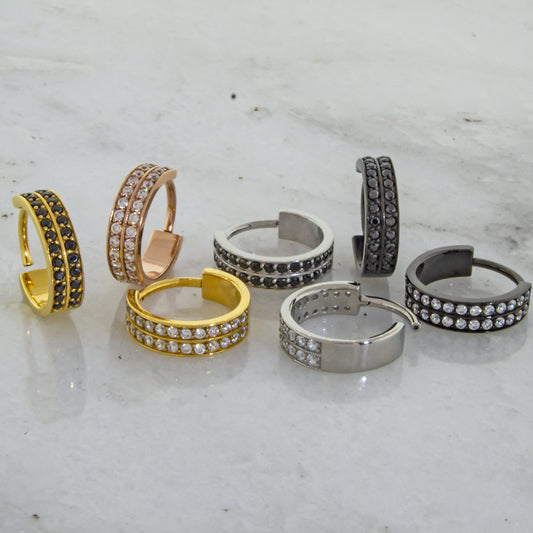
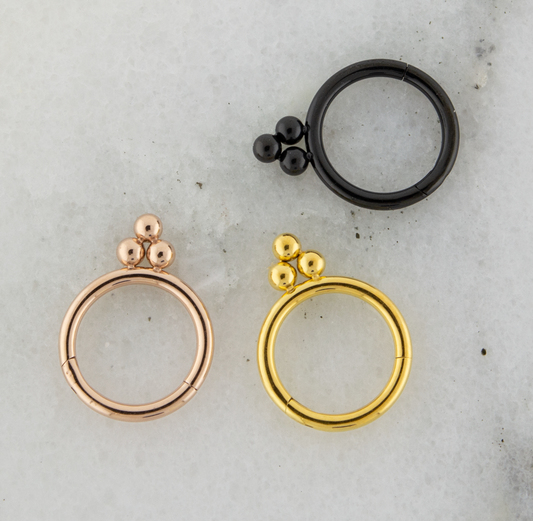
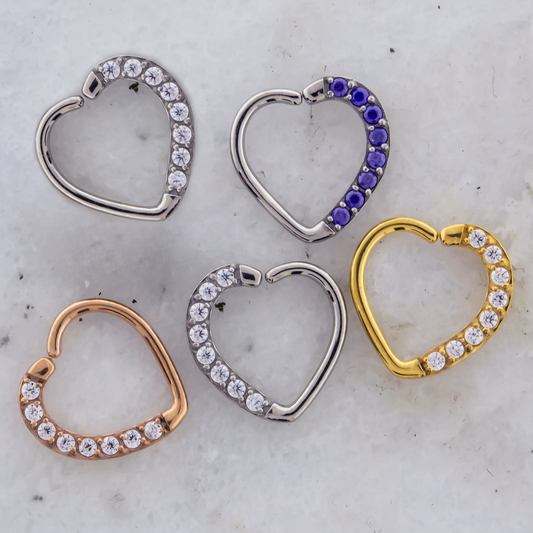
A hinged stainless steel ring uses a small hinged section of the ring that clicks open and closed. The hinge sits on one side of the ring, and a latch or snap mechanism on the opposite side holds it shut. Steel hinged segment rings are the easiest of the three types to insert and remove because both hands can work with the ring open before snapping it closed in the piercing. This makes them a practical choice for septum piercings, daith piercings, and helix placements where direct access to close a captive ring can be awkward. Decorative hinged segment rings with gem-set fronts and textured surfaces are also available in this collection for wearers who want more visual detail.
See more: 316L Steel Hinged Segment Rings
Gauge and Diameter Guide by Piercing
Gauge determines the thickness of the stainless steel ring wire, and diameter determines the overall size of the circle. Both must match your current piercing for the stainless steel ring to sit correctly. A ring at the wrong gauge will not thread through the piercing; a ring at the wrong diameter will either press against the skin or hang loosely away from it.
Septum:
- Standard gauge: 16G or 14G; 12G and 10G for stretched septum placements
- Common diameter: 8mm to 10mm for most adult anatomies
- Notes: An 8mm ring sits closer to the base of the nose; a 10mm ring hangs slightly lower
Nose (Nostril):
- Standard gauge: 20G or 18G
- Common diameter: 6mm to 8mm
- Notes: Smaller diameter rings sit flush against the nostril; larger rings wrap more visibly around the edge
Helix and Cartilage:
- Standard gauge: 16G or 18G
- Common diameter: 8mm to 12mm depending on exact placement and ear anatomy
- Notes: Forward helix placements typically use smaller diameters (6mm to 8mm)
Daith:
- Standard gauge: 16G
- Common diameter: 8mm to 10mm
- Notes: Anatomy varies significantly and affects fit more here than in most other placements
Lip and Eyebrow:
- Standard gauge: 16G or 14G
- Common diameter: 8mm to 10mm
- Notes: Match diameter to original piercing jewelry for a correctly proportioned fit
Nipple:
- Standard gauge: 14G
- Common diameter: 10mm to 14mm depending on anatomy
- Notes: Allow enough room for natural movement and tissue depth
When in doubt about your current gauge, the most reliable method is to measure your existing ring wire with a gauge wheel or ask your piercer at your next visit. Guessing gauge and ordering incorrectly is the most common reason for returns in ring jewelry.
How to Measure Your Current Ring
For diameter, measure the inner width of your current stainless steel ring from one inner edge to the opposite inner edge in a straight line. That measurement in millimeters is your inner diameter. For gauge, a gauge wheel provides an accurate reading by fitting the ring wire through numbered openings until you find the snug fit.
See more: 316L Steel Seamless Rings
Best Ring Picks by Piercing Type
Different placements have distinct requirements for stainless steel ring type, gauge, and diameter. Matching all three produces a ring that fits correctly, stays in place, and looks proportional to the anatomy.
Septum Piercings
The septum is the most popular placement for stainless steel rings in this collection. A stainless steel septum ring at the right gauge and diameter is one of the most rewarding jewelry upgrades you can make for a healed septum. All three ring types work well here once the piercing is healed. Captive bead rings at 14G to 16G in 8mm to 10mm are the classic choice. Seamless rings give a cleaner visual with no ball hardware showing, which suits wearers who prefer a minimal look that can be flipped up inside the nose when needed. Hinged clickers are the most practical for frequent wearers who change their septum jewelry regularly, and decorative hinged designs with gem fronts make the stainless steel septum ring a statement piece rather than just an accessory.
Nose (Nostril) Piercings
Nostril stainless steel rings are typically 20G or 18G at 6mm to 8mm diameter. Seamless rings and captive bead rings both work here, with seamless being the more popular choice for the nostril because the clean line sits against the nostril curve without a ball that can shift position. A 6mm seamless ring at 20G is the most commonly purchased size for healed nostril piercings with average anatomy. If your nostril is larger or if you prefer more ring visibility, 8mm is the next standard size up.
Ear Cartilage Piercings
Helix, daith, conch, and tragus piercings all work well with a stainless steel ring, and this collection offers a practical, affordable option for healed cartilage placements. Helix piercings typically use 16G or 18G at 8mm to 10mm. Daith piercings use 16G at 8mm to 10mm, though the curved anatomy of the daith means that hinged clickers and captive rings both fit but seamless rings require careful sizing. Conch piercings accommodate larger diameter rings (10mm to 14mm) because the placement sits deeper in the ear bowl and a ring needs sufficient diameter to wrap around the cartilage comfortably.
Lip and Eyebrow Piercings
Lip piercings that use stainless steel rings typically sit at 16G or 14G with 8mm to 10mm diameter. A stainless steel captive bead ring is the standard choice for labret lip placements when a ring is preferred over a labret stud. Eyebrow piercings also use a 16G stainless steel ring in 8mm to 10mm, with the ring wrapping across the ridge of the brow. For both placements, choosing a ring diameter that matches the original piercing jewelry ensures the ring does not pull or gap against the tissue.
Why 316L Implant-Grade Steel for Body Rings?
Not all stainless steel rings are produced to the same material standard. Choosing an implant-grade stainless steel ring over a fashion-grade alternative is the most important single decision for any piercing worn full-time. The term "surgical steel" is used broadly across the industry and does not correspond to a verified material specification on its own. Understanding what 316L implant-grade steel means and how it differs from lower-grade alternatives helps explain why it is the baseline material standard for healed body jewelry at professional piercing studios.
What 316L Implant-Grade Steel Means
316L is a specific austenitic stainless steel alloy in the 316 family. The "L" designation indicates low carbon content, which reduces the risk of carbide formation at grain boundaries during manufacturing. In practical terms for body rings, implant-grade steel has a tightly controlled chemical composition that minimizes free nickel content and limits nickel ion migration into surrounding tissue under normal daily wear conditions. The material is non-porous, corrosion-resistant, and maintains its surface integrity without tarnishing under standard wear and cleaning conditions.
316L Steel vs. Fashion-Grade Stainless Steel
Fashion-grade stainless steel jewelry sold through general marketplaces and fashion retailers may look identical to implant-grade steel but is produced to a looser alloy standard. The nickel content in fashion-grade steel can be significantly higher, and the surface finish is typically less refined. For a ring worn in a piercing around the clock, the difference between implant-grade and fashion-grade is not cosmetic. It affects how much metal migration occurs against piercing tissue over months and years of continuous contact. Every stainless steel ring in this collection is produced to that implant-grade specification, not simply labeled "surgical steel."
PVD and Anodized Finishes on Steel Rings
Some rings in this collection feature PVD-coated or anodized finishes in black, gold, rose gold, and colored tones. PVD coating bonds the finish to the 316L steel surface at a molecular level through a vacuum deposition process, producing a finish that is significantly more resistant to chipping and peeling than electroplating. Anodized titanium-plated finishes on steel rings follow a similar principle. Both finish types maintain the implant-grade stainless steel core while adding color options that plain steel cannot provide.
When to Consider Titanium Instead
If you have a confirmed nickel sensitivity or are purchasing a ring for a fresh or healing piercing, ASTM F136 implant-grade titanium is the appropriate material upgrade. Titanium is fully nickel-free by composition and is the most biocompatible metal available for body jewelry. For healed piercings with no known metal sensitivities, implant-grade stainless steel is a reliable and cost-effective choice. The
ASTM F136 Titanium Rings collection covers the same ring types in nickel-free titanium for wearers who need that option.
Why Shop 316L Stainless Steel Rings at Pierced Addiction?
Pierced Addiction carries stainless steel rings sourced to 316L implant-grade specification and produced to the surface finish standards used in professional piercing studios. The collection of stainless steel rings covers captive bead, seamless, and hinged segment styles across gauges from 20G through 10G and diameters for every common stainless steel ring placement.
Verified 316L implant-grade steel. Every ring in this collection is manufactured to the 316L specification, not labeled with the term without material verification.
All three ring types in one place. Captive bead rings, seamless rings, and hinged clickers are all available here, along with sub-collections for each ring type if you want to browse by style.
Wide gauge and diameter range. From 20G fine nostril rings through 10G septum rings for larger gauge wearers, the size coverage extends beyond what most general retailers carry at the implant-grade steel standard.
Free domestic shipping and same-day processing. Orders over $25 ship free via USPS economy. Domestic orders placed before 1pm are processed the same day.
Frequently Asked Questions
Find quick answers to the most common questions about 316L stainless steel rings, ring types, sizing by placement, and material safety.
What is the difference between a captive ring and a seamless ring?
A captive stainless steel ring uses a separate ball that sits in tension between the two ring tips to close the ring. A seamless ring is a single continuous circle with a cut through the band that you twist open and closed. Seamless rings have no visible hardware from the front.
What diameter septum ring should I get?
Most adult septum piercings fit comfortably at 8mm to 10mm inner diameter. An 8mm ring sits closer to the base of the nose; a 10mm ring hangs slightly lower. If you are replacing existing jewelry, measure your current ring's inner diameter before ordering.
Is 316L stainless steel safe for healed piercings?
Yes. A 316L implant-grade stainless steel ring is formulated to minimize nickel ion migration and is non-porous, making it appropriate for long-term daily wear in healed piercings. For fresh or healing piercings, ASTM F136 titanium is the preferred material choice.
What gauge is standard for nose rings vs septum rings?
Nostril piercings typically use 20G or 18G. Septum piercings typically use 16G or 14G. The two placements use different gauges and ring sizes, so they are not interchangeable.
Can stainless steel rings tarnish or rust?
Implant-grade 316L stainless steel rings do not tarnish under normal wear conditions. Lower-grade stainless steel or steel with plated finishes may discolor over time, which is one of the practical reasons to confirm the ring is 316L implant-grade rather than generic "surgical steel."
Stainless steel rings in captive, seamless, and hinged styles cover every common ring placement from septum and nostril to helix, daith, and lip. Shop the full selection of stainless steel rings above to find your ring type, gauge, diameter, and finish.